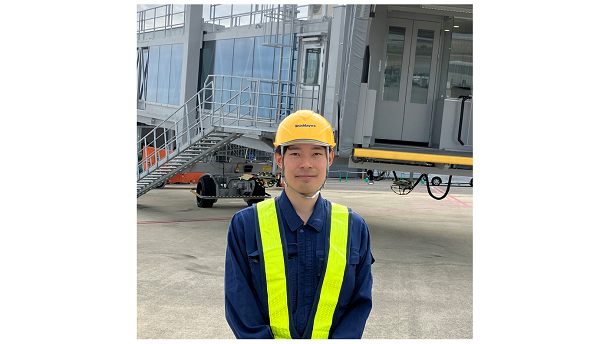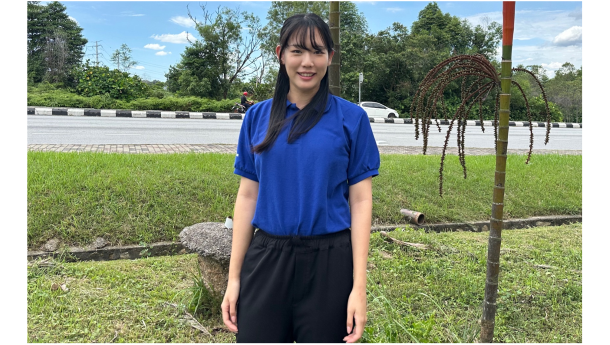

"Crossing Cultures: ShinMaywa's People Connecting with the World"
Our long-term management plan [SG-Vision2030] sets a target of achieving overseas sales of over 100 billion yen, and accelerating our overseas expansion is an essential theme for further growth in the future.
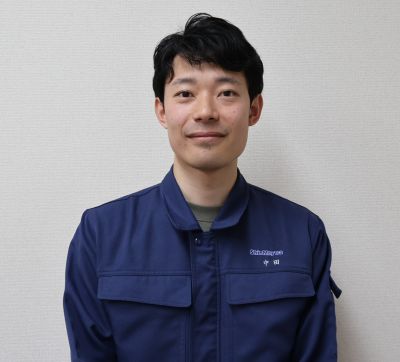
Our employees, working with overseas branches and business partners, are taking on global challenges "while remaining in Japan." This article explores their role as a bridge connecting Japan and the world.
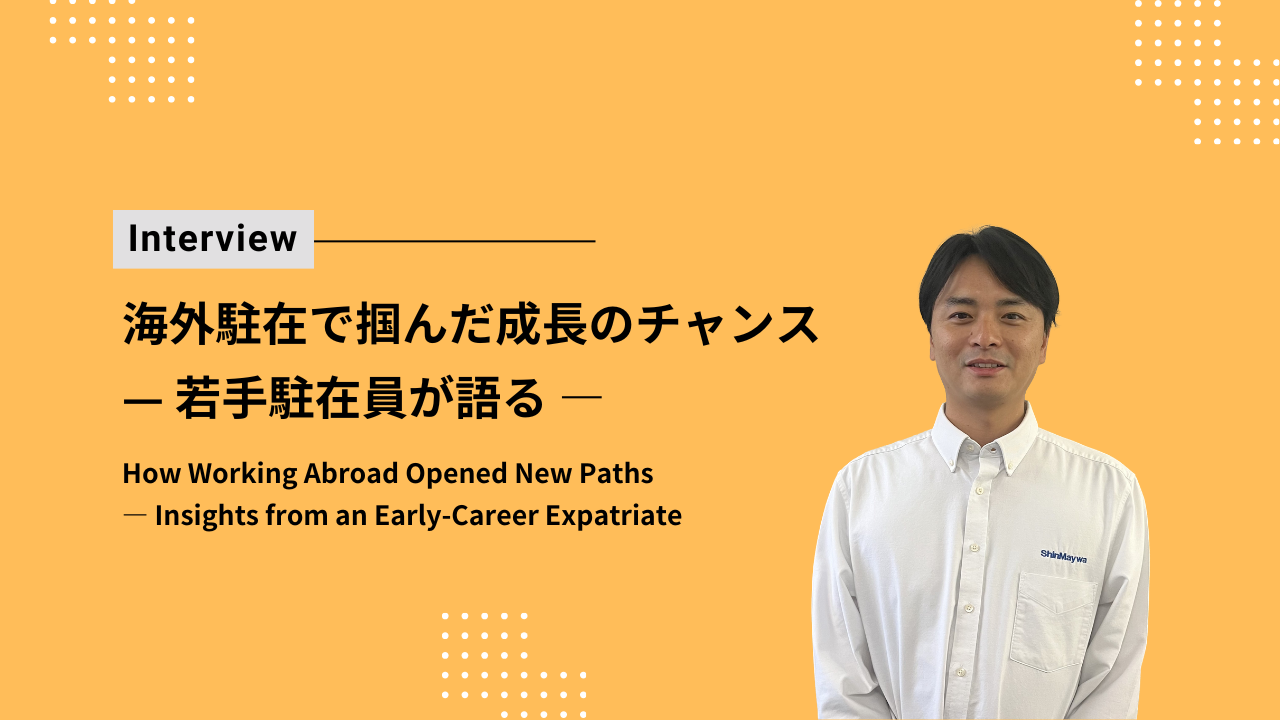
Joined the company in April 2018. Assigned to the Mechanical Design Group, Design & Engineering Department, Airport Facilities Division Parking Systems Division
He is in charge of the mechanical design of aircraft passenger boarding bridge (hereinafter referred to as boarding bridge), and was also involved in specification adjustments, drawing creation, and development of new functions.
In 2020, he made his first business trip to Singapore, where a group company is based, and was involved in supervising the assembly of boarding bridge and performing maintenance work at Changi Airport.
He continued to make business trips to Malaysia and other locations, and in 2025, he had a total of three overseas business trips.
Have you had any sense of accomplishment or memorable experiences in your overseas-related work?
I have fond memories of the "barrier-free type (girderless)" project delivered to Takamatsu Airport in October 2025. Although the delivery was domestic, I traveled to the site to check on the fabrication and assembly status being carried out overseas.
Boarding bridge business of Parking Systems Division does not have a domestic production base, and manufacturing in cooperation with overseas group companies. Fabrication *1 is carried out at ShinMaywa Aerobridge Malaysia Sdn. Bhd., and assembly *2 is carried out at ShinMaywa (Asia) Pte. Ltd. (Singapore). The completed boarding bridge are divided into multiple sections, transportation by sea, and installed at the airport site.
Checking the fabrication and assembly status is a crucial task, as it involves verifying that production is progressing according to the drawings and customer requirements by inspecting the actual product. In the fabrication process, we held detailed discussions in advance regarding specifications that differed from conventional designs, such as the girderless function, and worked closely with the on-site quality control personnel, which allowed us to complete the process without any major problems. In the assembly process, I was particularly impressed when on-site workers pointed out defects in fabricated parts that I had overlooked, allowing us to correct them in the shortest possible time.
I believe that we were able to proceed with important projects without major problems thanks to the cooperation of those around us, including employees and expatriates at our overseas subsidiaries.
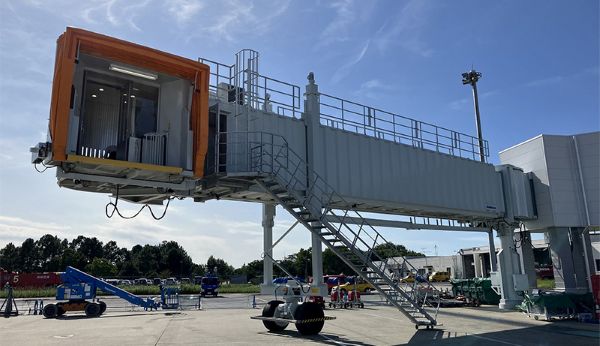 ▲
First "Barrier-free type (Gutter-less)" aircraft passenger boarding bridge delivered to Takamatsu Airport
▲
First "Barrier-free type (Gutter-less)" aircraft passenger boarding bridge delivered to Takamatsu Airport- *1 Metal fabrication: This involves cutting, bending, welding, and painting metal sheets such as iron to create the framework and outer walls of boarding bridge
- *2 Assembly: This involves assembling fabricated parts by welding or other means, and preparing them for installation at the site.
Have you noticed any differences between work styles and values in other countries and those in Japan?
In Japan, we have commissioned a Japanese company to produce a full-scale model (mockup), and they asked us many very detailed questions beforehand to ensure there were no misunderstandings regarding the drawings.
On the other hand, overseas (though this depends more on the local subsidiary and individual characteristics than on the country itself), I've noticed a tendency to quietly proceed with work, excluding obvious errors. As a result, there are times when areas for improvement, such as design flaws or poor work efficiency, are not immediately visible.
Are there any differences between Japan and other countries, or any core values you cherish in your global work?
As mentioned earlier, since they work diligently and quietly, when I visit the factory, I try to observe the work as much as possible and communicate with them to elicit any difficulties or areas for improvement. Opinions such as "This drawing is hard to read" or "This shape is difficult to work with" are shared with my supervisor and then reflected in the drawings.
While I receive advice from my supervisor on the impact of these changes on the overall design from a risk management perspective, there is a culture of "actively incorporating what can be improved," and I feel that it is an environment where opinions can be easily reflected.
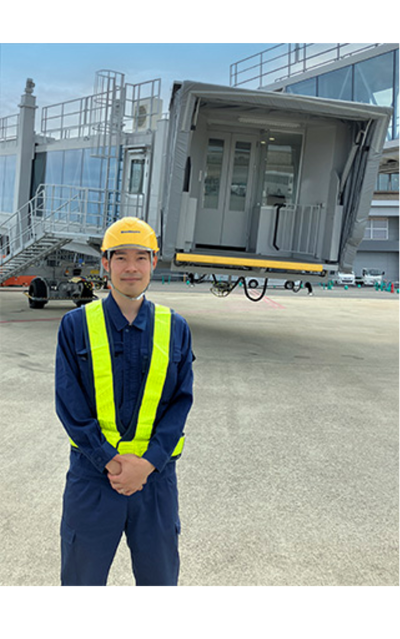 ▲Nakata-san (with aircraft passenger boarding bridge in the background)
Are there any practices you're doing in Japan to enhance your global awareness?
Communication with employees of our overseas subsidiaries is almost entirely in English. I wasn't particularly good at English to begin with, but since my involvement with overseas companies has increased, I've been trying to expose myself to English as much as possible by watching YouTube videos and using learning apps during my commute and other free time.
Do you have any future goals or things you'd like to achieve as a "global talent"?
Compared to my seniors and superiors, I still have little experience with overseas business trips, and I feel like I'm still learning. First, I want to absorb the good points of my seniors and build up my experience into my own skills. In the future, my goal is to become someone who can clearly articulate my own thoughts and what I want to convey, and who can act as a bridge to local subsidiaries and facilitate smooth communication.
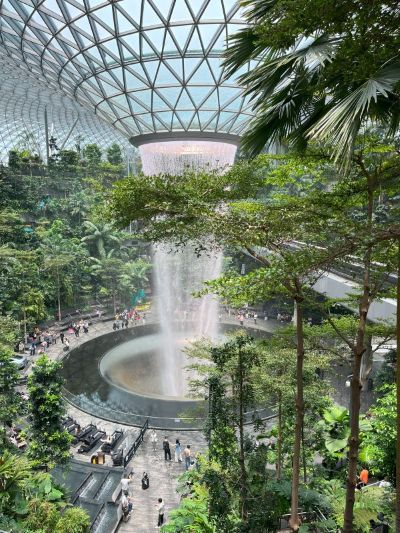 ▲Jewel Changi Airport, a complex adjacent to the terminals of Singapore Changi Airport (Photo by Nakata-san)
At Singapore Changi Airport, our aircraft passenger boarding bridge boasts a 100% market share.
Currently, ShinMaywa (Asia) Pte. Ltd. is working to secure orders for the boarding bridge to be newly established in the new terminal building, which is scheduled to open in 2030. Ltd., with the entire group working together to address this.
We have high expectations that the challenges led by Nakata-san will lead to further acceleration of overseas expansion across the ShinMaywa Group!