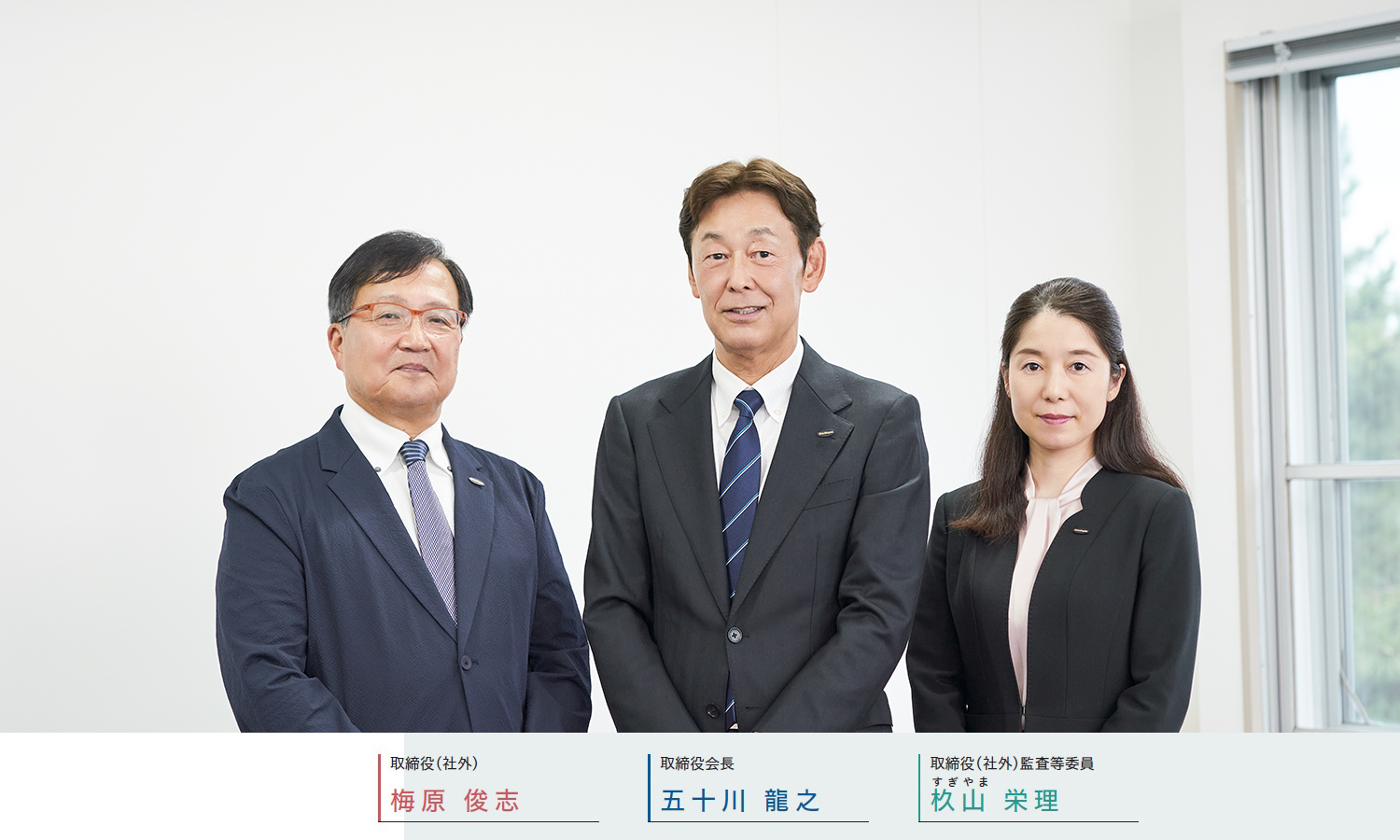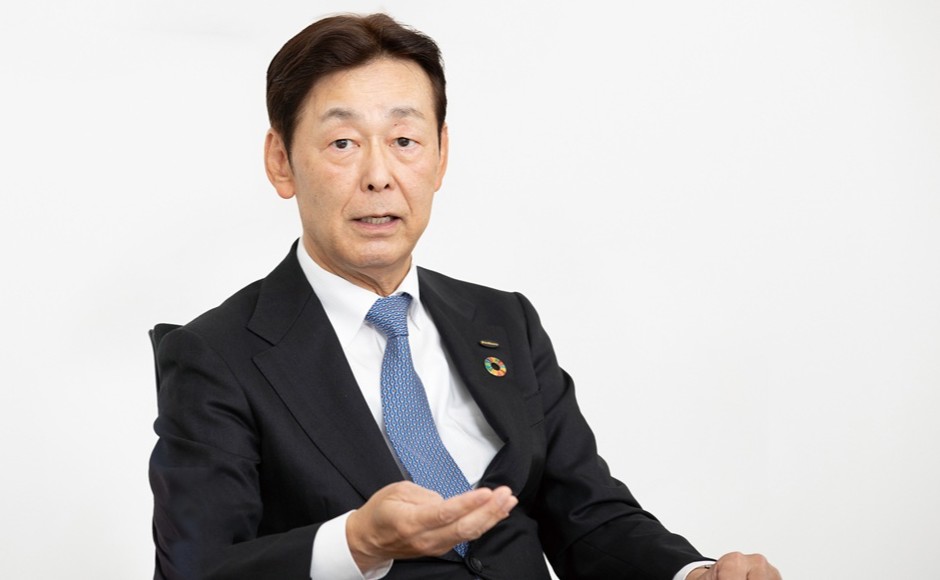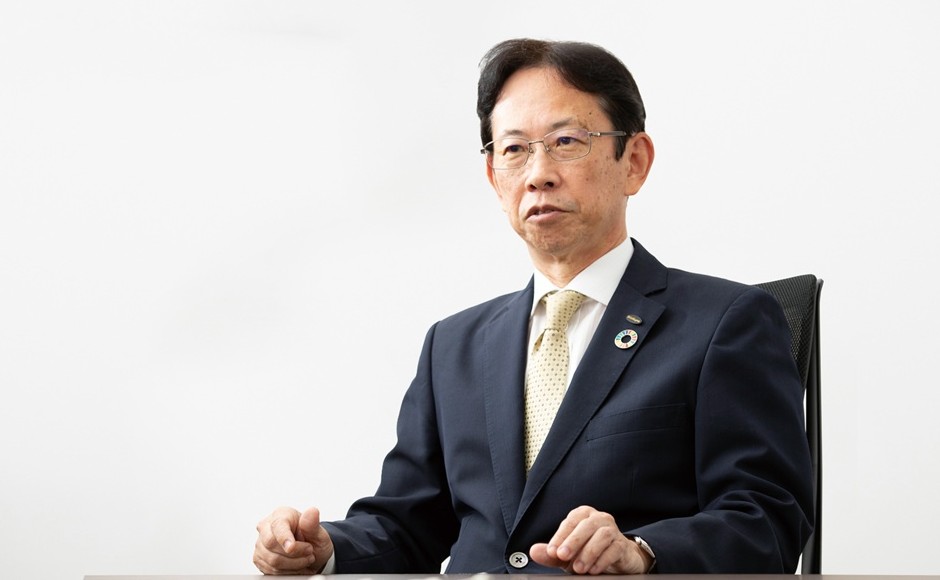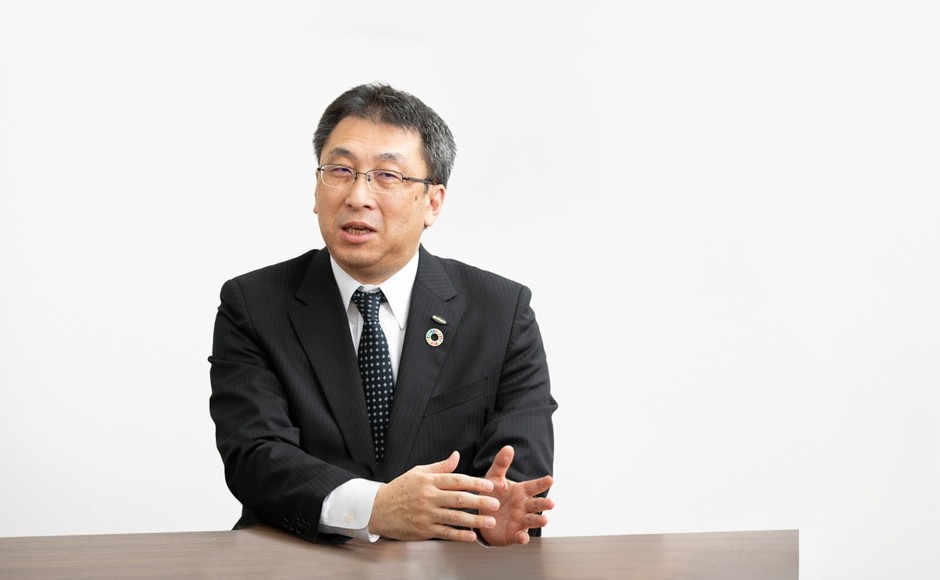

Tripartite Discussion Among Directors

Long-term vision and prospects
- Expanding profits within a sustainability management structure -

Aspiring to its long-term vision, the ShinMaywa Group is taking concrete steps forward through the long-term management plan, SG-Vision 2030. That long-term plan comprises three successive medium-term management plans, which combine to chart the course to FY2030.
Now at the midpoint of SG-Vision 2030, three officers reflect on the progress of our initiatives, the challenges we face, and the efforts on the road ahead.

Assessing current business performance

Isogawa

One of our objectives in formulating SG-Vision 2030 was to set ambitious goals that are not easily within reach—targets relatively far from our current position. By doing so, we aimed to establish challenging policies and strategies that would mark a departure from past medium-term plans and thereby create a stronger sense of urgency to accomplish the aims. That mindset, we believed, would better propel transformation and renewal across the Group.
Although we formulated SG-Vision 2030 in 2021 with a ten-year horizon, we already find ourselves at the stage of mapping out concrete, realistic paths to those goals. Our efforts to reach the net sales target of 400 billion yen, roughly double the level at the time, have brought the 300 billion-yen mark into sight. Going forward, we will focus on building on that growth by pursuing strategic, synergy-maximizing M&As with companies both in Japan and abroad.
Net sales provide the resources that drive all management activity, but two other components that we prioritize in our work to achieve the SG-Vision 2030 goals are profitability and capital efficiency.

Oda

At first, the target of 400 billion yen in net sales felt pretty ambitious. But thanks to all the steady, tireless efforts the business segments have put in, net sales have continued to grow. Orders received have reached record levels, too.
That said, inflation is driving surges in raw material and labor costs. Profit totals may be rising, but our profit ratio remains flat. That reality poses a challenge. With inflation likely to continue for the time being, boosting our profit ratio will require us to deliver added value that meets customer expectations.

Kume

As the officer in charge of finance, I anticipated the many risks the COVID-19 pandemic could pose for cash flow and made preparations accordingly. In the end, however, our strength as a company responsible for parts of the social infrastructure came through and kept us out of the scenario we were concerned might occur. While institutional investors often voice concerns about our diversified “conglomerate” model, the pandemic showed me just how much of a strength it is.
When it comes to the challenges we face on the performance side, I share Oda-san’s view.

Long-term business strategy: Progress and challenges

Isogawa

Each of our five business segments is working to expand sales, pursue growth, and expand, but the SG-Vision 2030 targets go beyond what they can accomplish simply by keeping their current approaches going. To do what we can to close in on those objectives, we are implementing new strategies and measures to generate earnings in ways that differ from past methods. One common thread linking the segments is a push to incorporate digital technologies into existing business areas. For our aircraft passenger boarding bridges, for example, we have developed a system that allows the bridge to automatically dock with an aircraft at the push of a button. The feature delivers added value that allows airports, which require on-time operations, to help offset labor shortages. To expand this system in Asia, where our market share is high, we will need to build a broader track record and increase earnings—by offering it as an optional upgrade for bridges already in service, for example.
In the waste collection area, meanwhile, we aim to move beyond selling refuse compactors alone. End-to-end processes for collection, disposal, and recycling are taking shape in some countries, and we are partnering with local companies to propose integrated collection setups that incorporate the waste collection efficiency system we are now developing. If successful, these kinds of initiatives could yield highmargin strategies that also boost customer satisfaction.

Oda

Alongside promoting the growth of existing businesses, the long-term strategy of SG-Vision 2030 includes cross-cutting themes like “acceleration of overseas expansion,” “strategic M&As,” and “new business creation.” While some segments have stagnated in their acceleration of overseas expansion, I believe we can still achieve long-term growth overall. Still, reaching our target of 100 billion yen in annual overseas sales is a formidable hurdle to clear. We need to move quickly to explore and implement effective measures—like introducing new business models that include DX, as the President has emphasized—that can deliver both scale and profitability.
One area where we are already moving ahead along those lines is the aircraft passenger boarding bridges we were just discussing, a category where we have a strong delivery record in Asia. We are working to go international with the long-term maintenance contracts we have sold here in Japan, for example, and we have won an order from an airport in Vietnam for our recently developed fully automated docking system. These efforts reflect our commitment to enhancing added value.

Isogawa

Sales are at the source of everything. In expanding our scope and strengthening our market presence, M&A is one effective approach. With future market realignments of our main businesses, efforts to broaden lineups to meet customer demands, and other developments on the horizon, we will carefully identify suitable partners and work to integrate them into the ShinMaywa Group.

Management measures with an emphasis on capital efficiency

Kume

Institutional investors have been asking more often about the soundness of our balance sheet. To realize sustainable growth, we have to achieve both higher earnings and sound finances. That is why we keep a watchful eye on our balance sheet and carefully evaluate M&A and other investments in advance against internal criteria before making our decisions—that, in short, is our mission on the management team.
There was once a time when being “debt-free” was what won companies praise. Today, though, we emphasize capital efficiency through indicators like equity ratio (aiming for around 40%) and net D/E ratio, or net debt-to-equity ratio (aiming for 0.5 or less). When we make investment decisions, we use net present value (NPV) and examine recovery plans before committing.
Last year, we obtained a rating assessment to get an objective evaluation of our financial soundness and put ourselves in position for future diversification in funding. The result—A- (“high capacity to meet financial obligations”)—was in line with our self-assessment. Having an objective confirmation of our financial soundness is definitely reassuring.
At the same time, we still have room to improve our capital efficiency. For example, we worked to help employees understand how maintaining appropriate inventory contributes to ROIC by running an article in our internal newsletter explaining the “ROIC inverse tree.” We try to avoid calling for one-size-fits-all approaches, though, since some sites face parts shortages that prevent production. Flexibility in judgment is important to us.

Oda

Stock markets place substantial importance on price-to-book ratio (PBR). To maintain a stable PBR above 1.0, we also need to raise our price-to-earnings ratio (PER)—which essentially equates to convincing the market of the Group’s future value. There are no shortcuts in getting there. If we execute our long- and medium-term management plans and achieve each milestone on the way, I think we can build a stronger sense of trust in our brand and plans for the future. For now, our main focus is on meeting the goals of the medium-term plan currently in progress, SG-2026.

Kume

In FY2024, our ROE rose above 8%, exceeding the prior year’s level. Going off the formula for PBR (ROE × PER), however, our PER level sits below expectations. That suggests the market has not yet priced in confidence in our future. To bring our PER to appropriate levels, we need to strengthen our investor-relations activities and release information in a timely fashion so that we can first gain better recognition in the market and then build higher expectations for future growth. Ultimately, the goal is to use these efforts to raise our market capitalization.

Isogawa

While the average PER in the transportation equipment field is 14–15, ours remains around 12, which makes it hard to deny that we are undervalued.
Communication is a big factor in that, I think. Discussions with institutional investors have given me a real feel for how vital it is to convey both our vision and our actual performance. We send a message to our shareholders in the form of dividends. But to bring PER up to fair levels, our approach needs to start with laying out our vision and then continually build on that with concrete information on where we are now and how we plan on reaching our destination. If we stay diligent in pursuing those aims, we can cultivate the “credibility” that Mr. Oda mentioned and make ourselves a stock investors choose.

Oda

We explain ROIC to employees through our internal newsletter and other channels, but it’s also important to translate those explanations into concrete examples so that everyone can take better ownership of it. As one way to elevate the awareness of each and every employee, we set key performance indicators (KPIs) at the division level and then roll them down into organization-specific policies. That helps establish links between ROIC and individual work.

Kume

To make connections between employee behavior and ROIC, it helps to tie in incentives somehow—linking to evaluation systems, for example. From an accountingoriented perspective, one idea would be to expand the evaluation items for sales personnel beyond just order value and volume. We could also assess performance that improves ROIC, such as success in pricing negotiations or shortening the collection period for accounts receivable.

Oda

Adding ROIC-related action to evaluation items could also provide an entry point for actively incorporating DX, like making judgments based on data analysis results. That kind of on-the-job behavior could help improve customer efficiency and quality, as well. Changes in awareness can be a driving force that moves us from monozukuri (manufacturing) to kotozukuri (creating experiences and solutions).

Strengthening the management foundations: Human resources strategy

Isogawa

All the core concepts for strengthening our management foundation under SG-Vision 2030 are important, but the one we put the strongest emphasis on is the human resources strategy. “Cultivating people” involves laying out a human resources portfolio with a focus on the types of talent we need, providing training to translate that portfolio into reality, and then creating places where the individuals we have cultivated can thrive.
While we develop employees in line with our own curriculum, we also enlist the help of outside experts to bolster our human resources in highly specialized fields. We sense some shortages in areas that are essential to SG-Vision 2030, such as DX and global talent, and we have received reports that some businesses are scrambling to secure licensed professionals. Every company faces talent shortages, of course. In the current environment, it will be vital for us to foster the kind of workplace environment that makes people want to choose ShinMaywa over others.

Oda

In working to enhance our DX talent, we just recently completed basic training for a group of candidates that we selected internally. We believe that in the next step, it is important to match the knowledge those potential DX specialists have gained with our business strategies and help them level up by getting practice to supplement their training.
The same goes for global talent. We need to provide base-level education aligned with our business strategies and place people in environments where they can make use of their experience overseas. Matching the right talent with the right opportunities is crucial.

Isogawa

For global talent, the focus used to be mainly on landing orders in individual countries. Going forward, however, we need people who can negotiate with local companies and build strong relationships. That is why, when we brought a Korean company into the Group via an M&A, we sent senior management in from the get-go to drive the post-merger integration process and help personnel on the ground develop the capabilities for better execution. I hope that more and more people gain that kind of experience and develop the skills to thrive in leadership roles that transcend business segments, energizing and elevating Group management.

Kume

We also need to boost operational efficiency through the tools we have at our disposal. On the finance side, we have significantly reduced workloads by introducing AI technologies; the benefits are palpable. Expanding the scope of these successes across the company is important. So is creating opportunities to learn. We now operate in an era where everyone—not just younger employees but even us in senior management—have to engage in reskilling.

Isogawa

The process evaluation system we introduced in FY2022 is one of the initiatives that reflects the aims of SG-Vision 2030. Our approach traditionally involved evaluating performance based on goal achievement for that specific fiscal year, but we felt that would not foster a long-term mindset. For that reason, we reworked the system to incorporate “process” evaluation. Having more employees willing to tackle stretch goals and tough challenges that take time to achieve is vital for a company like us committed to sustainable growth—and we will continue to value people with that endeavoring mindset.

Oda

Starting this fiscal year, we have also made process evaluation part of the annual President’s Awards. Initiatives involving DX, global talent, or new business creation—topics we have been talking about today—are normally time-intensive. We wanted to create an opportunity to evaluate and give recognition to approaches and processes. By adding that element into the President’s Awards and taking other steps along similar lines, we aim to raise motivation and engagement among employees who make up the human resources portfolio we are after.

Isogawa

Together, we can give shape to a system that actively rewards people who understand the direction the company is aiming for and pursue bold endeavors to drive progress accordingly.

Strengthening the management foundations: Environmental preservation

Oda

In our efforts to help prevent global warming, we are working toward a target of cutting total CO2 emissions by 38% from FY2017 levels by FY2030. On a nonconsolidated basis, we far surpassed our FY2024 target. We also now collect information on CO2 emissions on a larger scope, including major Group companies in Japan and overseas, which allows us to disclose results on a consolidated basis.
For total waste generated, we have set a target of reducing volume by 10% from FY2020 levels by FY2030. Here, too, we met our FY2024 target.
That said, all of these targets are absolute values. As sales increase under SG-Vision 2030, emissions will naturally rise as well. Bringing emissions down on a consistent basis under those conditions will be no easy task. Still, we view the sustained pursuit of our reduction goals as part of our corporate mission.
One effective way to reduce emissions is by installing more efficient equipment. While investments of that type may weigh on ROIC, lowering our environmental impact is essential. We have thus created a framework to prioritize these investments separately from ordinary ones.
We are also reviewing parts of our materiality (key issues) to support customers in reducing their environmental burdens through the products and businesses we provide. In line with our long-term vision of “advancing urban, transportation, and environmental infrastructure,” we are incorporating approaches such as reducing environmental impact, responding to increasingly frequent natural disasters, and promoting labor saving and efficiency. These ideas are already beginning to produce concrete output.

Isogawa

In 2023, we expressed our support for the recommendations of the Task Force on Climate-related Financial Disclosures (TCFD). What we need to do in our business activities is not only view potential climate change as a risk but also see it as an opportunity—to contribute to environmental preservation through our products in ways that ultimately generate earnings. Looking at the scenarios that our business segments have drawn up, you can see just how closely our businesses are tied to social infrastructure. For example, multiple business divisions are involved in the electric vehicle (EV) market. As EV adoption spreads, our contributions to CO2 reduction will grow.
The initiatives Mr. Oda was just explaining epitomize CSV activities (efforts to create social and economic value). We want to build a corporate group that centers on a foundation of business activities, goes beyond the narrower CSR (corporate social responsibility) perspective, and aspires to CSV.

Oda

To give one example of external ESG evaluations of these activities, CDP (a UK-based NGO that operates an environmental disclosure system for companies and public bodies) gave us a rating of “B-.” The rating came in lower than we had expected because of differences in the standards for calculating Scope 3 emissions (indirect emissions not produced by the company itself). Responding to the assessment will take some time, but it is important that we share within the company how rating levels can affect factors like borrowing interest. We also need to ensure that everyone understands the main thrust of the assessment. 
FTSE (a UK-based firm that calculates and manages stock indices and provides related financial data) rated us at 2.8 in 2024, down 0.1 from 2.9 in 2023. We believe the addition of risk management as a new evaluation item affected the rating. From this result, we inferred that our risk management may have appeared insufficient from an external perspective. We are thus responding this fiscal year by reassessing key risks and working on them in coordination with our business divisions.
Looking at these external evaluations as a whole, the points that the rating agencies made all relate to elements that make up the management cycle. It will be crucial to understand how they interconnect and develop our activities accordingly.

Kume

We also have a program to give awards to employees involved in these steady, relatively low-profile efforts. I want to make the most of the program to both lift motivation and give people more opportunities to see how company policies connect with these activities.

Strengthening the management foundations: Risk management

Isogawa

Right now, the risk we pay the closest attention to is inflation. Rising labor costs drive up costs across the board. To ensure profitability, we need to enhance the added value of our products and services so that customers will be receptive to higher prices. As I mentioned earlier in our discussion on human resources strategy, talent acquisition itself can also become a major risk factor. We need to keep asking ourselves whether we are a company people want to join—and want to keep working for. Fostering stronger engagement with employees is going to keep becoming more and more important.

Oda

In addition to surveys and other studies by external organizations, we are seeing increasing numbers of inquiries from customers and business partners about our ESG management. Because the outcomes often influence supplier decisions, we make sure our responses clearly communicate what we are doing along those lines. These surveys also help us identify our own weaknesses, which we address with targeted countermeasures.

Isogawa

In the past, a company’s credibility was defined by the quality of its products and services. Now, though, the companies that survive will be those that, on top of their business activities, can seriously engage with social issues and show improvement in those efforts.

Oda

A common view linking rating agencies and business partners alike is the notion that companies capable of sustained growth are those that manage from a multifaceted perspective.

Kume

One crucial risk we can never ignore is compliance violations. We deeply regret having violated Act on Prohibition of Private Monopolization and Maintenance of Fair Trade in the sale of our mechanical parking systems, and we are taking the countermeasures we announced this March to prevent the same thing from happening again.

Oda

Although we have had compliance training in place, we sincerely regret that our awareness level was not where it needed to be. As the President often reminds executives, proper conduct requires both knowledge and awareness. We know full well how essential it is to cultivate both through education.
I also oversee information security. As cyberattacks grow more sophisticated by the day, we are working to update our preventive measures so that we never create problems for our customers or business partners.
For a manufacturing-centric company, quality has a direct link to trust. Given our philosophy, which focuses on “a stable society and positive living environment,” we can never allow our products to compromise that stability. We are committed to making sure that our quality management system is always fully up to date and providing quality that continuously meets the needs of the times.

Isogawa

Every one of the risk responses we have discussed has a critical impact on management. We need to allocate sufficient resources as necessary and address them with determination.

Revisiting the vision for 2030

Kume

For our customers, we aim to be a company that demonstrates its value in every market—never content with the status quo, always delivering new value. For our employees, we seek to create a workplace that respects diversity, foster individual growth, and cultivate a culture of open-minded dialogue. For our shareholders, we want to balance profitability and growth, operate with high transparency, and enhance shareholder value. And for local communities, we aim to contribute to social development and reduced environmental impact through business activities that meet customer needs. These are the aspirations we want to embody.

Oda

The future I envision for 2030 is a corporate group that all stakeholders see as “indispensable,” a standing we achieve through management that enhances corporate value and pursues sustainable growth. Our management philosophy defines what we need to do to achieve that as a company that provides the products and services society needs: “bringing unstinting innovation for a stable society and positive living environment.” I see this philosophy as the ultimate product of our long-term vision’s call to advance “urban, transportation, and environmental infrastructure.” By basing our decisions on that philosophy in a way that harmonizes with all of our businesses, we will drive sustainable growth.
In FY2024, we also issued our Multi-Stakeholder Declaration, affirming that both our business partners and our employees are essential stakeholders in sustaining management. Making these two groups a key focus benefits customer satisfaction, which in turn ripples outward to shareholders and local communities.

Isogawa

One part of our ideal vision is to become a corporate group that the global market trusts through our businesses and services. Most of our customers are companies, but we need to remember that the ones who actually use and operate our products are individual people. I want ShinMaywa to be a company that gives them more satisfaction, as well.
I also want to prioritize engagement with the employees who we have been fortunate enough to welcome into the Group, fostering a shared sense of positive transformation as we move forward together. For shareholders, I envision us as having a strong, wide-reaching profile as a Group that, through its IR and SR activities, inspires hopes and expectations for medium- and long-term growth and earns their continued trust and support.
And in our local communities, I hope we maintain relationships where communication is smooth and effective so that we can make the most of our healthy connections not only in everyday life but also when disasters strike.
If we continue to pursue our management philosophy and embody the long-term vision that we set out in 2030, I believe society’s perception of ShinMaywa will shift—from a company that represents “stability” to one that promises “growth” and “expectations.” With that image in mind, we will move forward, step by step, toward achieving every one of our goals.