

In-line evaporation/sputtering systems for next-generation solar cells
Deposition solutions for the mass production of next-generation solar cells
Next-generation solar cells, including perovskite solar cells and tandem solar cells, are progressing from the research and development (R&D) stage to larger scale and mass production.
Thin-film deposition technology is needed to realize highly efficient solar cells.
Leveraging our long-standing expertise in large-scale vacuum equipment and vacuum transfer technology, we propose solar cell deposition systems capable of handling everything from research-grade substrates to meter-sized large substrates, contributing to improved power generation efficiency.
Our combined vapor deposition and sputtering process supports the formation of organic and inorganic material layers, transparent conductive films, and electrodes, helping to solve mass production challenges.
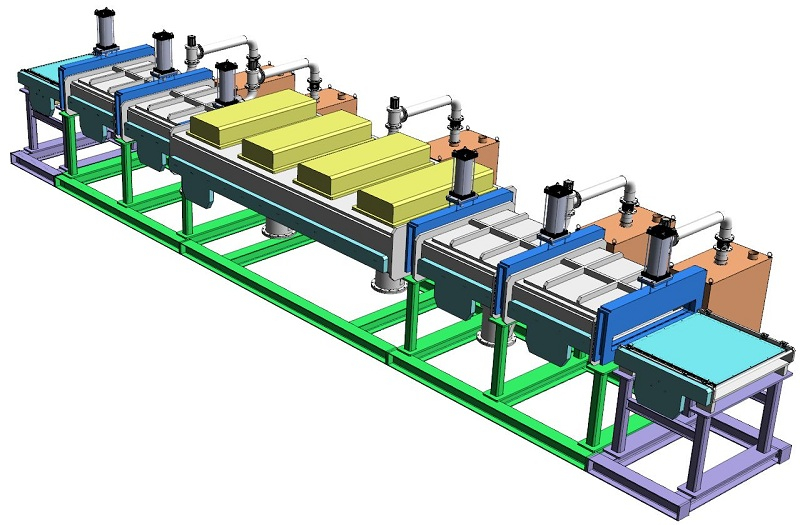
Features
Based on fundamental concepts such as in-line and cluster-type systems, we offer flexible, customized designs tailored to your specific film deposition process.
We support everything from small-scale systems for research and development to continuous transport and deposition of large substrates and sheets for mass-produced thin-film solar cells and flexible solar cells.
This combined vapor deposition and sputtering process allows for the formation of transparent conductive films such as ITO and AZO, in addition to perovskite and organic layers.
This technology minimizes damage to the organic and perovskite layers, which are sensitive to heat and plasma, thereby supporting the realization of high-efficiency solar cells.
We maximize "uptime," which is crucial in mass production. The film deposition source is designed for continuous operation of 1 to 2 weeks, minimizing downtime due to maintenance. In addition, we improve the material utilization efficiency of sputtering targets (ITO, AZO, zinc oxide, titanium oxide, etc.), contributing to reduced running costs.
In the manufacture of next-generation solar cells and organic devices, moisture and oxygen in the atmosphere are major factors in product degradation. This system is equipped with a nitrogen atmosphere loading/unloading mechanism, which suppresses product degradation by preventing atmospheric exposure.
Specifications & Key Technologies
| System Configuration | Batch type, Inline type, Cluster type | |||
|---|---|---|---|---|
| Compatible Substrates | Small substrates for R&D to meter-class large substrates | |||
| Deposition Methods | Evaporation (Resistance heating, K-cell, Multi-point simultaneous evaporation) Sputtering (DC, DC pulse, RF) | |||
| Key Technologies | Low-damage sputtering, High-efficiency target utilization | |||
| Transfer & Environment | Nitrogen atmosphere L/UL, Atmospheric transfer mechanisms | |||
Details and specifications of the above configuration can be changed according to customer requests.
Expected future applications
- It is expected to be applied to automotive solar cells and lightweight solar cells, and will also contribute to the development of power generation devices for EVs.
- Applications in power generation systems integrated with buildings, such as BIPV (Building Integrated Photovoltaic) and building integrated photovoltaic systems.
- Use as mass production equipment for flexible solar cells and power generation films
- Application of silver nanowires to the mass production process of transparent electrodes and next-generation electrode materials.
- Application to the manufacture of ultralight power generation devices for wearable power supplies.
- Application to large-area film deposition processes for agricultural solar cells
- Applications in the intermediate layer and transparent conductive film formation process of tandem solar cells.
- Utilization as a mass production solution for high-efficiency solar cells by combining perovskite and silicon solar cells.
Contact Information
For product inquiries, please click the button below
Search for other products and services