
The Ozone Layer and Fluorocarbon Regulations
We will explain the impact of fluorocarbons on the ozone layer and introduce our company's approach to environmental protection.
Ozone and Freon Gas Usage
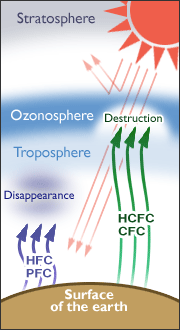
Freon is the general name, and chemical name is Fluoric-carbon (chemical materials bonding Fluoride and carbon), among which CFC (Chloro-fluoric Carbon: designated Freon) and HCFC (Hydro Chloro-fluoric carbon: designated Freon) destroy Ozone layer in space. "Specially designated Freon" contains chlorine.
HFC (HydroFluoric Carbon) is called Alternative Freon in general, which does not destroy Ozone layer in space due to no chlorine involved.
Since Ozone gas is unstable material, which is easily decomposed by absorbing solar energy. However, soon after being decomposed, the fluorine atom recombines with oxygen again and returns to Ozone to make balance as nature. In case Freon contains the chlorine atoms, the chlorine separated from Freon by ultraviolet light makes chemical bonding with Ozone. Then, Ozone can not return to original Ozone soon, which results in Ozone-destroy and generates Ozone-hole in space.
Influence of Ozone-destroy
Ozone layer forming in the stratosphere (10 - 50Km from the earth surface) works to protect human beings by absorbing hazardous ultraviolet beam (280 - 320nm of wavelength) in sunlight.
It was clarified in late 1970s that artificial materials of CFC (Chloro-fluoric carbon: designated Freon) that has been consumed in air-conditioners, industrial cleaning agents and form-generation agents have destroyed Ozone layer in space.
Once Ozone layer is destroyed, it is expected to have serious problems on the earth such as increase in covert disease ratio of skin cancer and cataract due to ultra violet light, decrease of photosynthesis, malign effect on DNA and negative impact to natural system.
Protection of Earth Warmth and Ozone Protection Layer
HFC (HydroFluoric Carbon) having Ozone destroy factor "0", a kind of coolant effects on earth warmth, once it is emitted to the atmosphere.

The "NeoCold ®" RCT series, an ultra-low temperature cooling device for vacuum equipment that we launched in February 2004, has a greater direct impact than natural refrigerant refrigerators, but depending on the power consumption of the natural refrigerant refrigerator, the product's total impact on global warming can be smaller.
Regulation on production, import and export of specially designated Freon
According to the "Montreal Protocol", Japanese government enacted the regulation in 1988, which is called "Law in regard with Ozone layer protection by restricting usage of the specially designated Freon", (Ozone layer Protection Law), with which Government regulated production, import and export of destructive materials of Ozone from July 1989.
| Atomic composition | Schedule | |
|---|---|---|
| CFCs Large impact | Cl, F, C | 1996 Elimination |
| HCFC-based Small impact | H, Cl, F, C | 2004 65% 2010 35% 2015 10% Completely phased out in 2020 |
| HFC-based No impact | H,F,C | none |
- * Based on 1989 consumption (production volume + import volume – export volume)
"NeoCold" RTC Series Carrying HFC Coolant
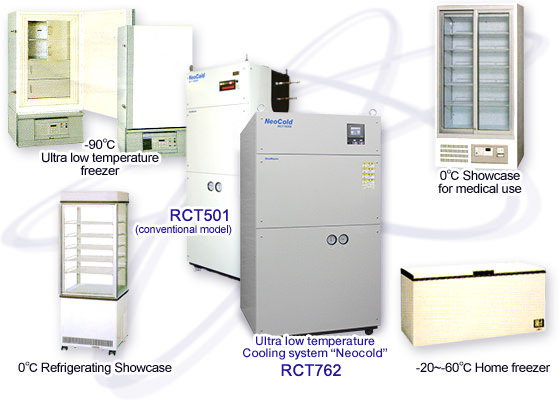
The "NeoCold ®" RCT series, an ultra-low temperature cooling device for vacuum equipment that we launched in February 2004, has an ozone depletion potential of 0. It is the industry's first ultra-low temperature cooling device that uses only refrigerants that do not destroy the ozone layer.
| Refrigerant | CFC12 | HCFC | HFC134a |
|---|---|---|---|
| Ozone depletion coefficient | 1.0 | 0.055 | 0.0 |
| Global warming potential (C.O. 2 =1.0) |
8,100 | 1,500 | 1,300 |
- * 100-year integrated value
In spite of no Ozone destroying, HFC134a influences on earth warmth if the coolant is emitted in atmosphere. It is obligated to recycle and to destroy the coolant by specific contractors.(Freon Recycle and Destroy Act: April 2002)
Record of Refrigerator Business at ShinMaywa
ShinMaywa has been engaged in ultra low temperature freezer and cooling system long years for captive market such as in vacuum coating system. The sealing technology of gas leakage has been well established, and demonstrated high reliability.