
Respecting human rights and establishing internal environments
*1: Non-consolidated figures; *2: Figures for the Group as a whole
Human Rights Policy
ShinMaywa Group recognizes that respect for human rights is an important corporate social responsibility, and is committed to sustainable corporate growth with an eye on the global market. To expressly show its stance toward respecting human rights, and uphold the International Bill of Human Rights adopted by the United Nations, the United Nations Guiding Principles on Business and Human Rights, and the ILO Declaration on Fundamental Principles and Rights at Work of the International Labour Organization (ILO), it has established the Human Rights Policy based on those international standards.
This Policy applies to all officers and employees of ShinMaywa Group. It is also shared with suppliers and other business partners of the Group to promote human rights initiatives.
1.Human Rights Policy
- 1Respect for fundamental human rights
We will respect fundamental human rights through sound business activities following internationally recognized human rights principles.
- 2Elimination of discrimination
We will not unfairly discriminate based on such factors as race, religion, nationality, gender, sexual orientation, age, disability, and educational background.
- 3Ban on harassment
We will not engage in speech, behavior, or other forms of harassment that violate human rights based on factors such as gender and social standing.
- 4Respect for labor rights
We will comply with national and regional labor laws and practices, as well as establish a sound labor-management relationship by respecting the right of collective bargaining and engaging in sincere dialogue with labor unions and individual employees.
- 5Ban on child labor and forced labor
We will not engage in child labor or forced labor in any country or region in which we conduct business activities. We will also respect children’s rights based on the Children’s Rights and Business Principles developed by the United Nations Children’s Fund (UNICEF).
- 6Establishment of comfortable workplace
environments
We will establish workplace environments where all employees can work in a safe, healthy, and lively manner. For our wage payment, we will comply with laws on the minimum wage, legal benefits and so forth of all nations and regions in which we conduct business activities. At the same time, we will comply with laws on working hours and overtime work.
- 7Contribution to local communities
As a good company and citizen, we will develop a relationship of trust with local communities and strive to undertake our activities by considering factors such as the social circumstance, culture, and practices of the local communities while endeavoring to collaborate with them to resolve regional issues.
2.Responsibility to Respect Human Rights
In the event that our business activities negatively impact human rights, we will fulfill our responsibility to respect human rights by taking appropriate steps to rectify the situation.
3.Education and Training
To comply with our policy on respect for human rights, we will continuously provide all officers and employees with appropriate education and training on respect for human rights to have the policy incorporated in all of our business activities and effectively implemented.
4.Identifying and Responding to Negative Impact on Human Rights Issues (Human Rights Due Diligence)
To prevent or alleviate negative impacts on human rights that arise from our business activities and can potentially affect society, we will conduct preventive surveys and evaluations as necessary and strive to conduct appropriate improvement activities and monitoring that take into consideration the risks involved.
新明和工業株式会社
代表取締役 取締役社長
槶原 敬士
Human rights due diligence
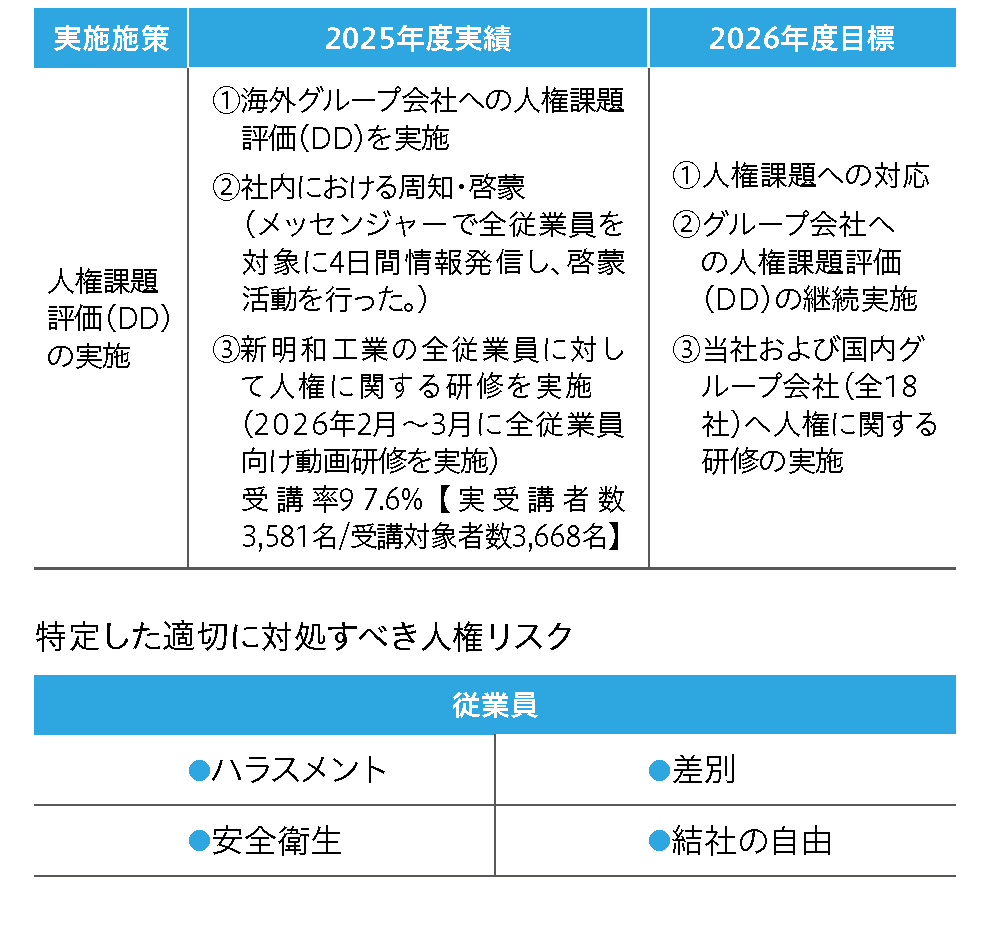
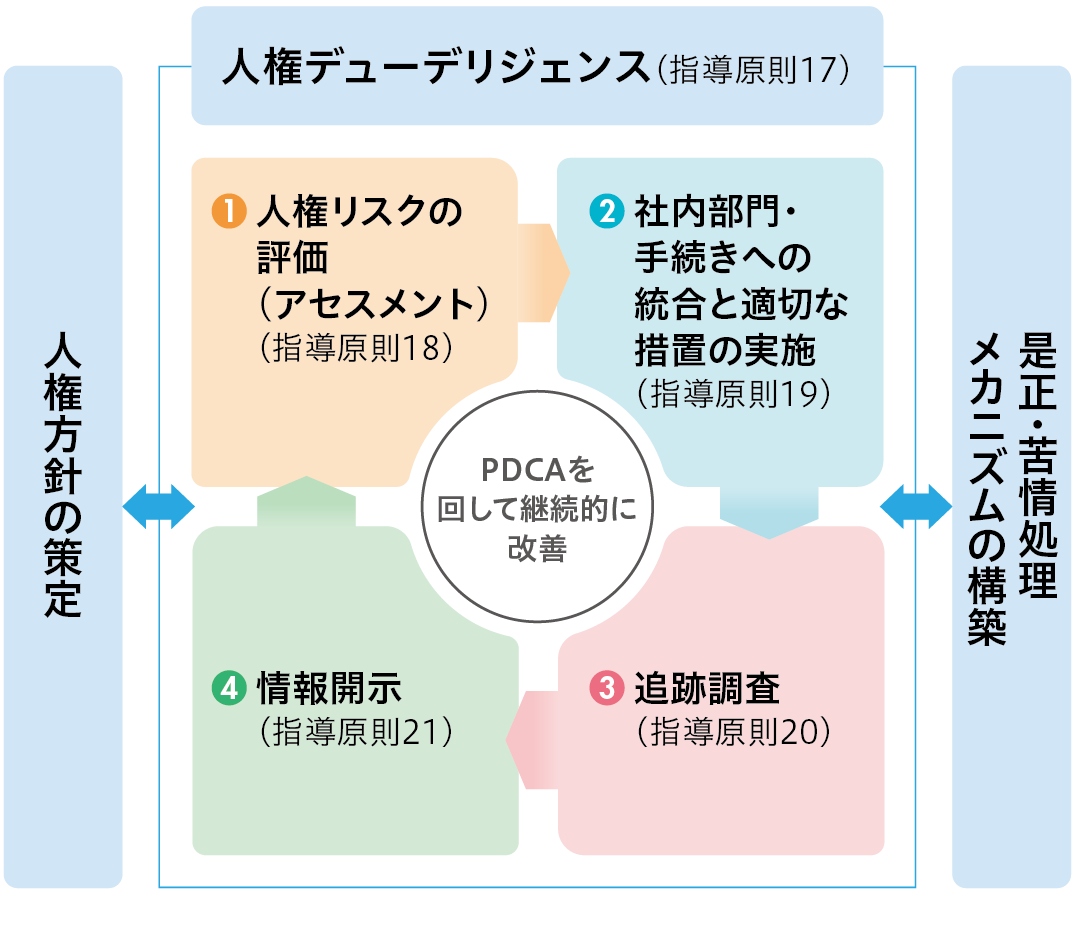
Under the ShinMaywa Group Human Rights Policy, the Group, for the purpose of identifying, preventing, and alleviating negative impacts of its business activities on human rights, has built a human rights due diligence process and works responsibly to take corrective action as necessary. Specifically, Social Subcommittee takes the lead in promoting activities to address human rights risks identified based on the Group’s business activities and strives to take appropriate action to prevent or alleviate such human rights risks.
We conduct continuous monitoring, including tracking the implementation status of corrective actions and continuously assessing human rights risk impacts.
If the Group’s activities are found to induce a negative impact on human rights or if involvement in such becomes clear through stakeholder dialogue or a grievance mechanism, we will work to remedy that through appropriate procedures.
Grievance mechanism
We have established whistleblowing contact points within and outside the Group so that, in the event of occurrence of a negative impact on human rights, we can take appropriate action to rectify the situation. Employees (including non-regular employees) of the Company and Group companies are eligible to report compliancerelated problems including human rights issues. In addition, we have established a contact point on our website to allow all stakeholders to report human rights issues.
当社グループの事業活動において「新明和グループ人権に関する方針」に反する対応その他の人権侵害が行われている、またはそのおそれがあることが認識され、通報窓口に情報提供があった場合は提供された情報に基づき事実関係を確認し、必要・適切な改善・救済措置を検討・実施します。
Dialogue between labor and management
Under the “ShinMaywa Group Human Rights Policy,” we comply with national and regional labor laws and practices through our business activities, as well as establish a sound labor-management relationship by respecting the right of collective bargaining and engaging in sincere dialogue with labor unions and individual employees.
労働組合は管理職を除く正規社員が加入対象で、加入率は98.6%です。(2026年3月31日時点)
We acknowledge that the labor union has labor’s three major rights (the right to organize, the right to bargain collectively, and the right to act collectively) and that seeking smooth business management and business development is a common interest for both the labor and management. In addition, we have established a management council and a division (plant) council as consulting organizations aimed particularly at explaining management policies, considering production plans, overcoming difficulties in production, improving production efficiency, maintaining and promoting health and safety, enhancing welfare and education, improving workplace environments, and establishing workplace discipline. We have also established a joint labor-management council and a central council for the purpose of maintaining and improving labor conditions and preventing or handling conflicts between the Company and the union.
At ShinMaywa Industries, the labor and management hold Working Hours Setting Improvement Committee meetings twice a year to share information and exchange opinions about initiatives aimed at developing environments and shortening total working hours to implement diverse and flexible working styles and enhance employee engagement, with a focus on preventing overwork. At the joint labor-management council, the labor and management set targets for the initiatives seeking to increase the childcare leave-taking and the paid leave usage ratios and promote the active participation of women, as well as share information, exchange opinions, and have discussions at each meeting.
At collective bargaining, the social context such as price trends and employees’ life designs such as childcare and caregiving are also taken into consideration. Accordingly, we investigate wage levels every year and set a wage level and compensation for employees that surely exceed the minimum wage. The labor and management share information, exchange opinions, and continue discussions to pay competitive salaries, and we work to pay wages necessary for all employees across the Company to maintain their standard of living.
Creating an organizational culture that draws on diverse human resources
The ShinMaywa Group will recruit and assign diverse human resources regardless of actors such as gender, age, nationality, religion, disability, educational background, and sexual orientation, and advance efforts to promote the creation of an organizational culture that draws on diversity.
Promoting the active participation of women
当社グループでは、女性活躍の推進は多様性における重要な要素と考えており、出産・育児といった経験をしながらでも、安心して仕事に取り組み、積極的にチャレンジしていくことのできる会社を目指しています。そのために、出産や育児などのライフイベントを迎えても働き続けられるさまざまな制度を整備し、男性・女性従業員双方の仕事と家庭の両立を支援しています。
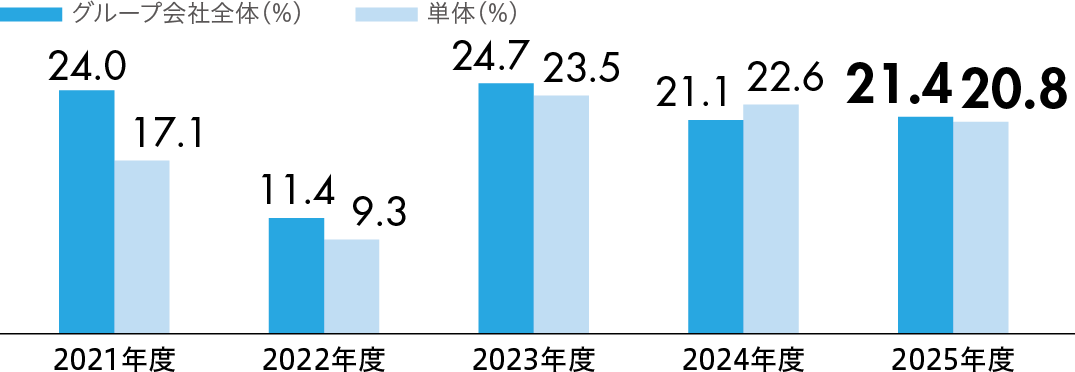
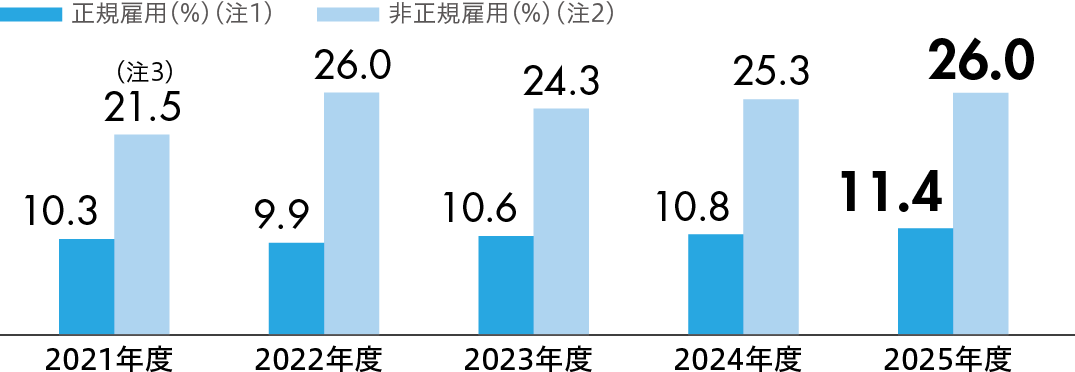
- (Note 1) Full-time employees
- (Note 2) Directly employed workers such as part-time workers, contract workers, and retired retirees. Dispatched staff are excluded.
- (Note 3) The decline is due to a decrease in the number of female employees (non-regular), and an increase in the number of non-regular employees joining the Group through M&As.
Recognized challenge in increasing the proportion of female managers
The Group is promoting the creation of workplace environments where employees can demonstrate their abilities irrespective of gender. However, owing to the nature of manufacturing business, the proportion of male employees is high especially in plants and production sections, and the percentage of female workers in management positions remains low. Based on the understanding of this structural challenge, we will provide women with more opportunities for recruitment, development, and assignment and pursue the creation of an environment where women can play active roles in management positions.
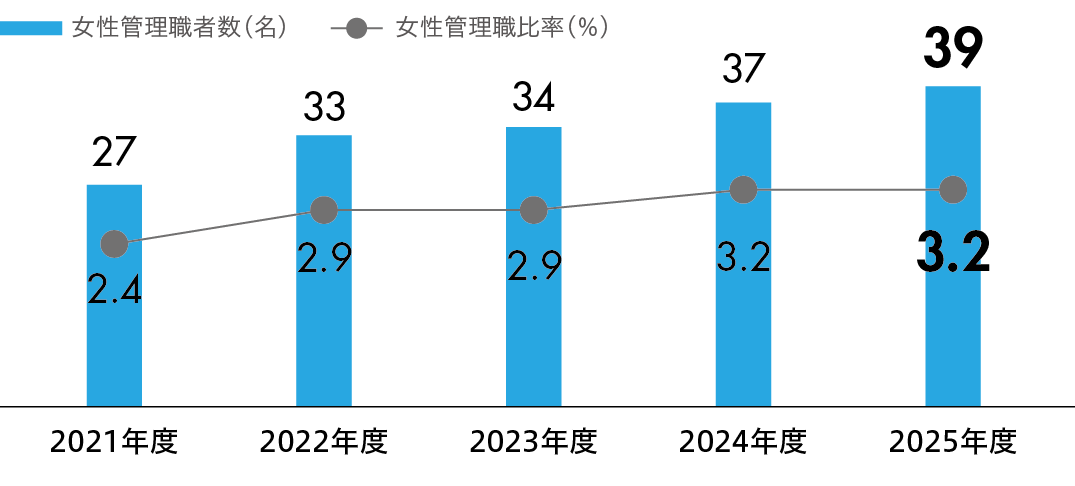
Measures to promote female’s active participation Action plan
Based on the Act on the Promotion of Women's Active Engagement in Professional Life, we have formulated an action plan to create a workplace envrionmental where women can thrive.
In order to increase the number of female employees and create environmental they can continue to work, we will formulate the following action plan.
1. Plan period: Two years, from April 1, 2026 to March 31, 2028
2. Our company's problem: The number of female applicants is low, and as a result, the number of female hires is low.
As a result, there are fewer women in managerial positions.
3. Goal:
(1) In order to increase the proportion of women among employees, the proportion of women among university and postgraduate graduate hires will be increased to an average of 20% or more during the planning period.
Goal: More than 20% within the planned period
Actual results: 21.7% (22.6% in FY2024, 20.9% in FY2025)
- <Initiative details>
-
April 2024~
- Aiming to hold an information session for female students, the content will be considered.
- Consider holding factory tours for female students.
- Female employees will act as recruiters and carry out recruitment activities targeting female students.
(2) To increase the number of female managers, the proportion of women among those at the section chief level or higher shall be set at 4% or more.
- <Initiative details>
-
April 2026~
- Fostering awareness and developing female management candidates through the proactive operation of training programs for female leaders.
- Promoting the development of a workplace environment that allows for a balance between work and family life.
Publication of information regarding female's active participation
Percentage of female workers among hired workers
| employment classification | FY2023 | FY2024 | 2025年度 |
| Regular employment | 13.7% | 11.8% | 13.3% |
| non-regular employment | 15.4% | 14.5% | 18.9% |
Difference in average years of service between male and female (as of the end of March 2026
| employment classification | male | female | Total |
| Regular employment | 18.3 years | 12.9 years | 17.8 years |
| non-regular employment | 9.9 years | 6.2 years | 9.1 years |
| Total | 17.6 years | 11.5 years | 17.0 years |
Promoting the hiring of people with disabilities
The Group is committed to establishing an inclusive society, where anyone who wants to work and has the ability to do so can take part in society through their work, regardless of disabilities, and is therefore promoting the hiring of people with disabilities.
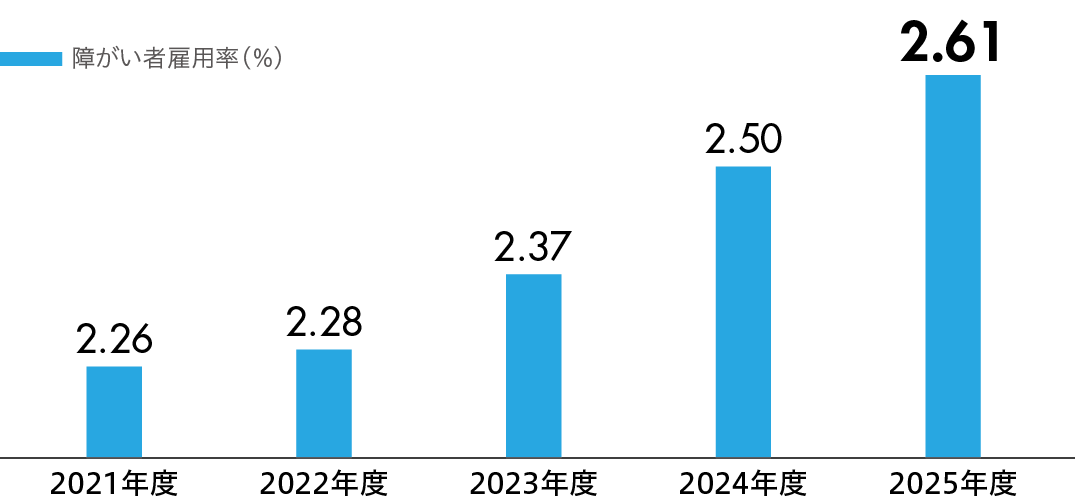
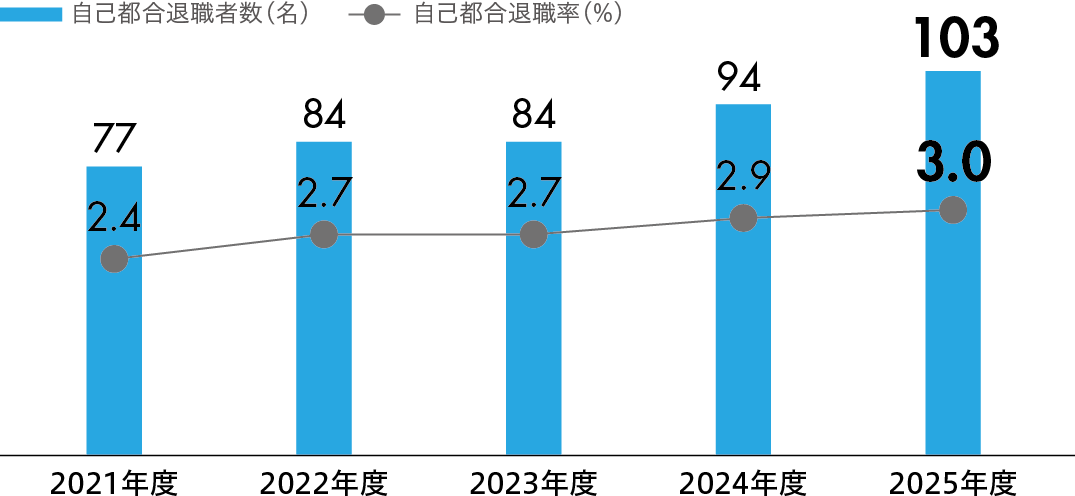
Number of voluntary separations
The Company has been promoting the creation of a workplace where diverse human resources can continue to work with peace of mind. As part of this initiative, we have been engaged in efforts to reduce the voluntary turnover rate. We are working to increase the retention rate and strengthen our human capital by fostering an environment where employees with diverse backgrounds in gender, age, life stages, etc. can play active roles according to their different values and working styles.
Hiring human resources at overseas locations
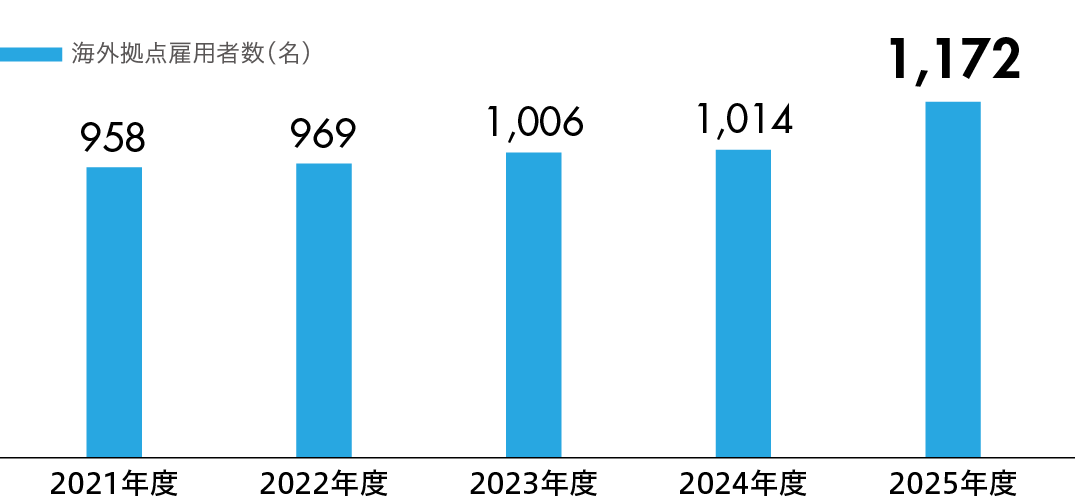
The Group believes that expanding its presence in overseas markets is essential for enhancing existing businesses and expanding our business domains. We have set a target of 100 billion yen in overseas sales in FY2030. In recent years, we have been working to gear up our overseas expansion by, for example, proactively pursuing M&As of overseas companies.
Developing systems to allow for diverse working styles
To enable our employees to balance work with their personal lives, we are enhancing our systems so that we can create a work environment that is comfortable for our diverse workforce.
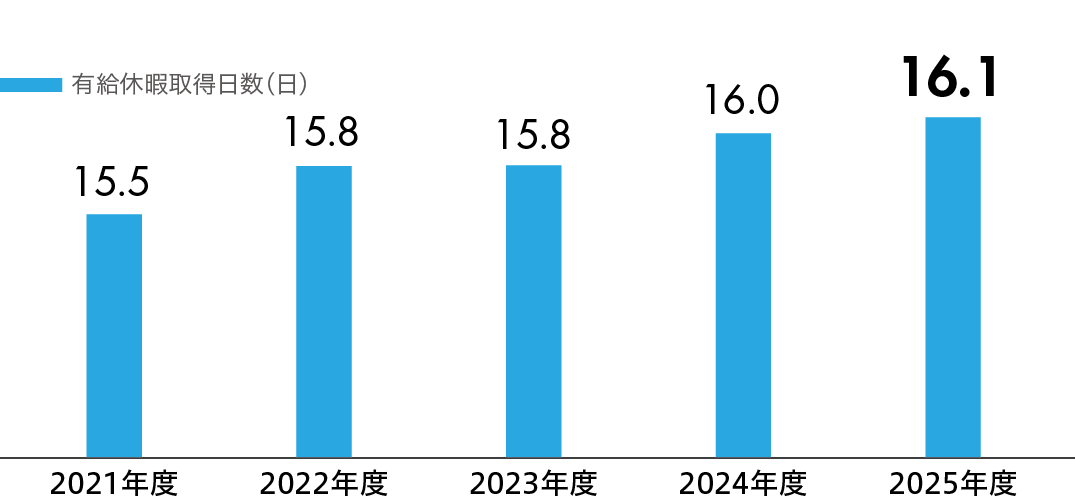
■Initiatives for preventing long working hours and for promoting the use of paid leave
As well as strengthening management of work hours in line with the establishment of legal limits on overtime hours, the Company has put in place various measures for reducing overtime work. To reduce long working hours, for example, we have set a company-wide day on which everyone leaves the office at the close of business hours. We are also working to promote the use of paid leave through introduction of a planned leave system.
Various systems for childcare and caregiving
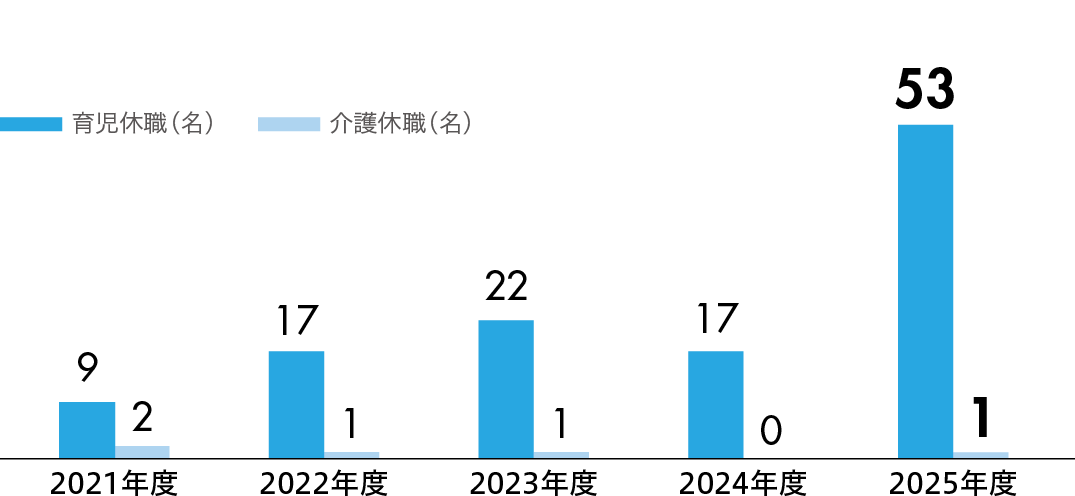
We have introduced childcare and caregiver leave systems and a shortened working hour system for employees with childcare and caregiving responsibilities. Using these systems, employees can take care of their children and family members without having to resign.
| Prenatal and postnatal maternity leave | Special maternity leave of eight weeks before and eight weeks after childbirth allows you to prepare for childbirth. |
|---|---|
| Childcare leave | In principle, childcare leave is available for one year, and up to two years if the Company deems it necessary. |
| Childcare leave | Employees can take up to 10 days of leave per year to care for children up to the age of elementary school entry. |
| Time for childcare | For the first year following childbirth, employees may take at least 30 minutes of time twice a day for childcare, in addition to break periods. |
| Shortened working hours (childcare/nursing care) | Employees can reduce their daily working hours to accommodate childcare or nursing care needs. |
| Flextime system | Our Flextime system has no core hours, making it FLexible enough to accommodate employees with childcare and caregiving responsibilities. |
| Nursing leave | If you need to care for a family member, you can take five days of leave per year for each family member. |
| Planned leave | This is a system that allows employees to take three consecutive days of planned paid leave once a year. |
| Consultation on child-rearing | This system allows employees to consult with a specialist about their childcare concerns. |
| Reemployment system | This is a system for rehiring former employees who wish to return to the Company, having previously had to resign due to personal circumstances, such as the transfer of a spouse, childcare, or caregiving. |
| Caregiver leave | A leave totaling one year is available to care for a family member who has been certified as requiring caregiving. |
| Cafeteria Plan | This is a system that subsidizes the costs of purchasing childcare and nursing care products and using facilities. You can also receive assistance with the costs of infertility treatment. You can also choose from a variety of other options, such as self-improvement and travel, that fit your lifestyle. |
Promotion of remote work
We are working to improve labor productivity, prevent long working hours, and enable diverse work styles through the promotion of remote work.