

Corporate Governance
2026年4月1日現在
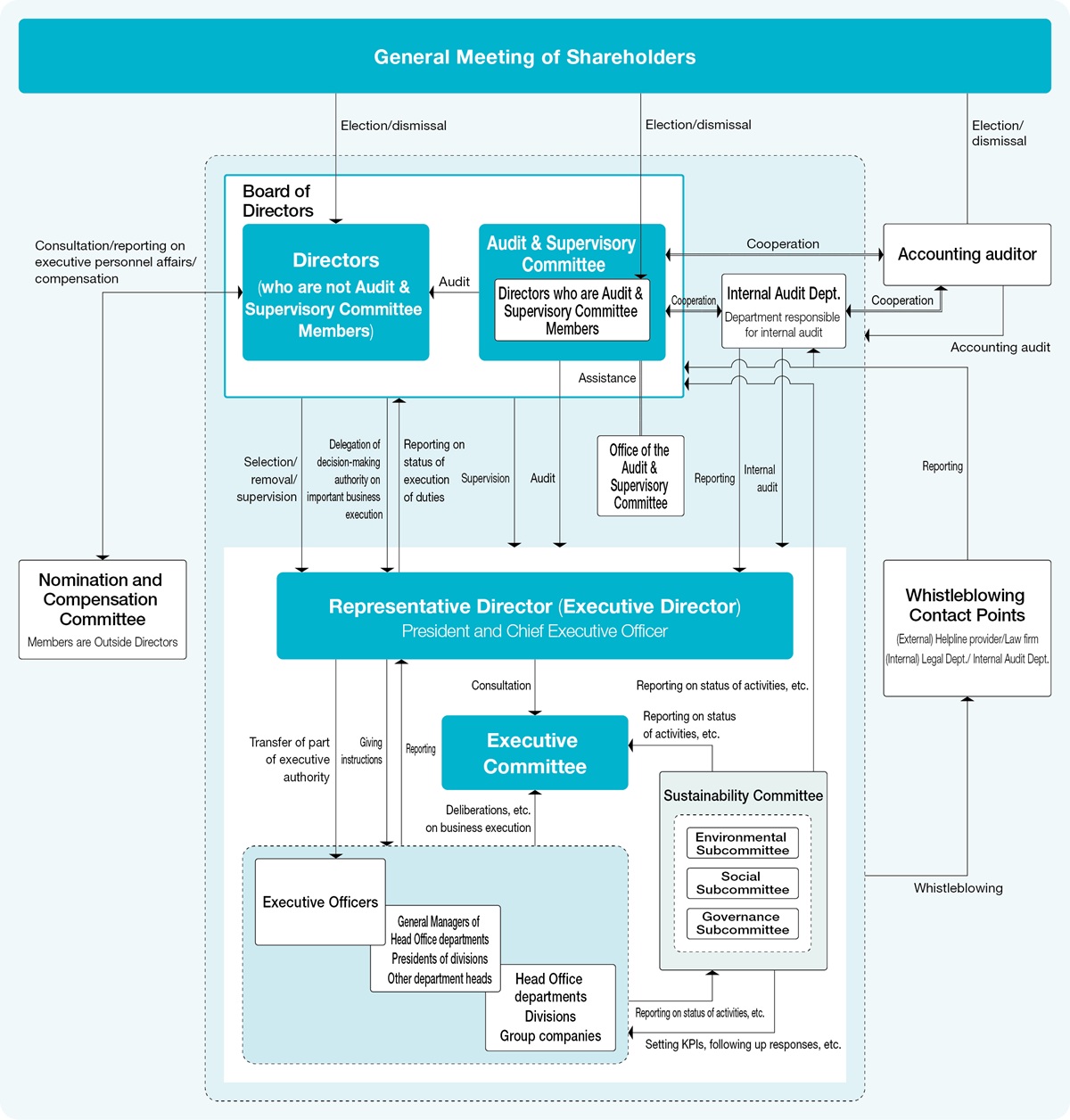
The ShinMaywa Group conducts corporate activities in accordance with relevant laws and regulations, as well as with social norms and common sense, and also ensures transparency and rationality in its management in order to sustainably increase its corporate value. In doing so, we believe that it is vital to create and operate a corporate governance system and also to continuously review and improve that system.
Overview of the corporate governance system and reasons for adopting the system
当社は、機関設計として「監査等委員会設置会社」を採用しています。「監査等委員会設置会社」を採用した理由は、取締役会の議決権を有する監査等委員である取締役を選任し、かつ委員の過半数が社外取締役で構成される監査等委員会を設置することにより、取締役会の監督機能の実効性のさらなる向上を図ることおよび監査等委員会と内部監査部門の連携の促進等を通じて監査体制の強化を図ることならびに取締役会の業務執行決定権限を取締役に委任することにより、取締役会の適切な監督の下、経営の意思決定および業務執行の迅速化を図ることができると考えたためです。
The diagram below provides an overview of our corporate governance system.
Corporate Governance System
Board of Director Meeting
In principle, Board of Director Meeting meets once a month to discuss and consider important management issues based on the medium- to long-term management plan, and to appropriately supervise the execution of duties by directors.
Our company currently has 10 directors (four of whom are Audit and Supervisory Committee members). Of these, six are outside directors (three of whom are Audit and Supervisory Committee members), making the majority of Board of Director Meeting outside directors. In addition, with the appointment of four female directors (two of whom are Audit and Supervisory Committee members), more than one-third of Board of Director Meeting is made up of women, and the composition of the Board of Directors takes gender diversity into consideration.
The Outside Directors are mainly expected to monitor management of the Company from an objective position that is independent of the management personnel, provide advice on management and provide broad and diverse perspectives for realizing increasing corporate value and sustainable growth over the medium to long term. They are selected from among persons who have management experience and other diverse experience, skills, and expertise and are effectively independent of the Company.
Audit and Supervisory Committee
The Audit and Supervisory Committee audits and supervises the execution of duties by directors in accordance with the audit plan. Directors who are Audit and Supervisory Committee members attend important internal meetings, including meetings of Board of Director Meeting, and also hear reports on the status of execution of duties by executives and employees, and inspect approval documents, thereby appropriately fulfilling their audit and supervisory functions.
The outside directors who serve as Audit and Supervisory Committee members are selected from among lawyers, certified public accountants, and individuals with backgrounds in other companies. They express their opinions regarding the execution of duties by directors based on their respective areas of expertise, thereby ensuring the neutrality and effectiveness of audits.
Directors who are Audit and Supervisory Committee members hold regular meetings with the President and CEO to receive reports on management and business conditions, and exchange opinions based on the status of audits and audit findings.In addition, with the aim of enriching discussions at Board of Director Meeting, outside directors who are not Audit and Supervisory Committee members exchange information and opinions.
Accounting auditor
Grant Thornton Taiyo LLC has been appointed as the accounting auditor, and by providing accurate management information, we have created envrionment where accounting audits can be conducted from a fair standpoint.
Nomination and Compensation Committee
With the aim of further enhancing the transparency and appropriateness of personnel matters and compensation for management, the Company has voluntarily established Nomination and Compensation Committee, which is consulted in advance when selecting candidates for officers and determining their compensation and bonuses.
The committee is composed exclusively of outside directors, ensuring its independence and fairness.
Executive Committee
The meeting is held multiple times a month depending on the agenda, with the purpose of formulating company-wide management strategies, deliberating and reporting important matters related to business execution, and deliberating Medium-term management plans.
全社サステナビリティ会議
当社は、持続的な企業価値の向上と社会的価値の創造を目的として、年2回、全社サステナビリティ会議を開催しています。本会議は取締役社長を議長とし、社内取締役、本社執行役員、事業部長などで構成され、サステナビリティに関する重要情報を適切に把握・評価するとともにサステナビリティ経営の実効性向上に努めています。
全社リスクマネジメント会議
当社が有するリスクに関する諸課題に対応するため、年2回、全社リスクマネジメント会議を開催しています。
Internal Audit Department
当社グループにおける内部監査は監査部が担当しています。監査部は、年度監査計画に基づいて当社および当社グループ会社を対象として内部統制の機能が有効に作用しているかを検証するとともに、その結果に基づく改善・効率化の提案等を行っています。また、内部監査の結果については、監査報告を取りまとめ、これを取締役会において報告しています。
監査等委員会、会計監査人および監査部が相互に連携・調整することで、効率的な監査の実施に努めています。
Executive Officer
The Company has adopted an executive officer system intended to strengthen management functions by transferring authority over individual business operations to executive officers in order to speed up decision-making processes and clarify executives’ responsibilities while freeing up the Board members (Board of Directors) to focus on evaluating individual businesses, making decisions about the allocation of management resources, and exercising supervision over business operations from a company-wide perspective. Through this executive officer system, the Company aims to enhance its corporate governance and realize higher operational efficiency.
The Company has 18 executive officers (one of whom also serve as directors), whose main duties are to carry out individual businesses.
| Name | Position/responsibility at the Company |
|---|---|
| Toshiki Kume | Director, Member of the Board / Senior Managing Executive Officer, Vice President of Finance&Accounting Division, and General Manager of Accounting Department |
| Kyosuke Nakano | Managing Executive Officer, Vice President of Innovation Strategy Division, and General Manager of Quality Assurance and Monozukuri Department |
| Katsuo Tanaka | Managing Executive Officer, Deputy Vice President of Innovation Strategy Division |
| Koichi Tamura | Managing Executive Officer, President of Fluid Division |
| Satoshi Nii | Managing Executive Officer, President of Industrial Machinery Systems Division |
| Hideyuki Mochida | Managing Executive Officer, President of Aircraft Division |
| 増田 健 | Managing Executive Officer, Vice President of Corporate Planning Division |
| Hiroaki Konishi | Managing Executive Officer, Vice President of Human Resources Division, and General Manager of Human Resources and General Affairs Department |
| Yoshihiro Nagao | Managing Executive Officer, President of Special Purpose Truck Division |
| Masahiro Namba | Managing Executive Officer, President of Parking Systems Division |
| Koji Fukai | Executive Officer, Corporate Planning Division, and General Manager of DX Promotion Department |
| Masatsugu Nakase | Executive Officer, Senior Vise President of Parking Systems Division |
| Takashi Akimoto | Executive Officer, General Manager of New Business Promotion Special Purpose Truck Division Division |
| Ichiro Kuwahara | Executive Officer, Senior Vise President of Industrial Machinery Systems Division, and General Manager of Enviromental Systems Department |
| 松本 泰孝 | Executive Officer, General Manager of Legal Affairs |
| 長井 諭 | Executive Officer, Senior Vice President of Fluid Division, and Vice President of Sales and Marketing Department of Fluid Division |
| 二宮 武司 | Executive Officer, Vice President of Sales and Marketing Department of Special Purpose Truck Division Division |
| 山岡 崇記 | Executive Officer, General Manager of the Audit Department and Head of the Audit and Supervisory Committee Office |
Regarding Board of Director Meeting and Other Committees Voluntarily Established regarding Corporate Governance
Activities of Board of Director Meeting
取締役会は、原則として毎月1回開催することとしており、2025年度においては合計14回開催されました。
個々の取締役の2025年度における取締役会への出席状況は、以下のとおりです。
| Position on Board of Director Meeting | Job title | Name | Number of attendance (attendance rate) |
|---|---|---|---|
| Chairman | President and Chief Executive Officer | Tatsuyuki Isogawa | 14回/14回(100%) |
| Director, Member of the Board/ Managing Executive Officer | Toshiki Kume | 14回/14回(100%) | |
| Director, Member of the Board/ Managing Executive Officer | 槶原 敬士 | 14回/14回(100%) | |
| Outside Director, Member of the Board | Seiko Nagai | 14回/14回(100%) | |
| Outside Director, Member of the Board | Toshiyuki Umehara | 14回/14回(100%) | |
| Outside Director, Member of the Board | 浅見 彰子 | 12/12(100%) | |
| 取缔役 监察等委员 | Koji Nishida | 14回/14回(100%) | |
| 社外取締役 監査等委員 | Eri Sugiyama | 14回/14回(100%) | |
| 社外取締役 監査等委員 | Fumihiko Kimura | 14回/14回(100%) | |
| 社外取締役 監査等委員 | 鈴木 敦子 | 12/12(100%) |
- ※「取締役会における地位」および「役職名」は、2026年3月31日現在のものです。
- ※浅見彰子および鈴木敦子の両氏の取締役会の出席回数(出席率)は、取締役に就任した2025年6月24日以降に開催された取締役会を対象としています。
2025年度における当社の取締役会では、長期経営計画[SG-Vision2030]で定めた経営目標を達成するため、中期経営計画[SG-2026]の基本方針に沿って①持続的成長の実現に向けたM&A戦略や海外事業の展開、新規事業の創出、②事業ポートフォリオ・マネジメント、③人的資本の強化、④リスクマネジメント、コンプライアンス体制の強化等に関する議案や、⑤代表取締役の異動・取締役社長の後継について審議したほか、⑥IR・SR活動を通じて得られた経営課題への対応等についても議論が行われました。
取締役会における審議において、社外取締役からは、それぞれが持つ多様な経験、知見等に基づき積極的な意見表明が行われております。
なお、2025年度開催の当社取締役会における主要なテーマに対し、各社外取締役から意見表明があった内容は、以下のとおりです。
取締役会における社外取締役の発言等の状況
取締役会における審議において、社外取締役からは、それぞれが持つ多様な経験、知見等に基づき積極的な意見表明が行われております。なお、2025年度開催の当社取締役会における主要なテーマに対し、各社外取締役から意見表明があった内容は、以下のとおりです。
| 1 |
持続的成長の実現に関する事項 |
|---|---|
| 2 |
事業ポートフォリオ・マネジメントに関する事項 |
| 3 |
人的資本の強化に関する事項 |
| 4 |
リスクマネジメント・コンプライアンスの強化に関する事項 |
| 5 |
代表取締役の異動・取締役社長の後継に関する事項 |
| 6 |
IR・SR活動の状況報告およびそれらを通じて得られた経営課題への対応に関する事項 |
Activities of Nomination and Compensation Committee
指名・報酬委員会は、当事業年度においては7回開催されました。
指名・報酬委員会では、代表取締役 取締役社長の後継候補者をはじめとする取締役、執行役員等の候補者の選定やサクセッションプランの運用、報酬水準等について検討しました。
| Position on Nomination and Compensation Committee | Job title | Name | Number of attendance (attendance rate) |
|---|---|---|---|
| Outside Director, Member of the Board | Seiko Nagai | 7回/7回(100%) | |
| Chairman | Outside Director, Member of the Board | Toshiyuki Umehara | 7回/7回(100%) |
| Outside Director, Member of the Board | 浅見 彰子 | 6/6(100%) |
- ※浅見彰子氏の指名・報酬委員会の出席回数(出席率)は、取締役に就任した2025年6月24日以降に開催された指名・報酬委員会を対象としています。
Activities of the Executive Committee
経営会議は、議案に応じて毎月複数回、開催することとしており、2025年度においては合計30回開催されました。
経営会議では、前述の取締役会に付議される議案についての事前の審議や中期経営計画[SG-2026]の進捗状況、個別の事業の遂行における課題等について検討、議論等を行いました。
| Position on the Executive Committee | Job title | Name | Number of attendance (attendance rate) |
|---|---|---|---|
| Chairman | President and Chief Executive Officer | Tatsuyuki Isogawa | 30回/30回(100%) |
| Director, Member of the Board/ Managing Executive Officer | Toshiki Kume | 27回/30回(90%) | |
| Director, Member of the Board/ Managing Executive Officer | 槶原 敬士 | 30回/30回(100%) | |
| 取缔役 监察等委员 | Koji Nishida | 30回/30回(100%) |
- ※「経営会議における地位」および「役職名」は、2026年3月31日現在のものです。
- ※上記のほか、議題に応じて事業部長である執行役員その他指名された者が出席しています。
全社サステナビリティ会議の活動状況
全社サステナビリティ会議は、原則として年2回開催することとしており、2025年度においては2回開催されました。
全社サステナビリティ会議では、サステナビリティ経営に関する方針、マテリアリティ(重要課題)、重要テーマおよびそれらに対応するKPIとその達成状況等について審議しました。
| 全社サステナビリティ会議における地位 | Job title | Name | Number of attendance (attendance rate) |
|---|---|---|---|
| Chairman | President and Chief Executive Officer | Tatsuyuki Isogawa | 2 /2 times (100%) |
| Director, Member of the Board/ Managing Executive Officer | Toshiki Kume | 2 /2 times (100%) | |
| Director, Member of the Board/ Managing Executive Officer | 槶原 敬士 | 2 /2 times (100%) | |
| 取缔役 监察等委员 | Koji Nishida | 2 /2 times (100%) |
- ※「全社サステナビリティ会議における地位」および「役職名」は、2026年3月31日現在のものです。
- ※上記のほか、議題に応じて事業部長である執行役員その他指名された者が出席しています。
全社リスクマネジメント会議の活動状況
全社リスクマネジメント会議は、原則として年2回開催することとしており、2025年度においては2回開催されました。
全社リスクマネジメント会議では、全社共通の重大リスクの選定、全社共通の重大リスクに対する対策の実施状況の評価等を行いました。
| 全社リスクマネジメント会議における地位 | Job title | Name | Number of attendance (attendance rate) |
|---|---|---|---|
| Chairman | President and Chief Executive Officer | Tatsuyuki Isogawa | 2 /2 times (100%) |
| Director, Member of the Board/ Managing Executive Officer | Toshiki Kume | 2 /2 times (100%) | |
| Director, Member of the Board/ Managing Executive Officer | 槶原 敬士 | 2 /2 times (100%) | |
| 取缔役 监察等委员 | Koji Nishida | 2 /2 times (100%) |
- ※「全社リスクマネジメント会議における地位」および「役職名」は、2026年3月31日現在のものです。
- ※上記のほか、議題に応じて事業部長である執行役員その他指名された者が出席しています。
Officer Compensation
1.役員の報酬等の額またはその算定方法の決定に関する方針に係る事項
当社における役員の報酬等の額またはその算定方法の決定に関する方針は次のとおりです。
取締役の個人別の報酬等の決定に関する事項
- 1 Basic Policy regarding Officer compensation
- We will create a compensation system that motivates "medium- to long-term performance improvement" and "sustainable improvement of corporate value" based on Management philosophy and Long-term vision.
- In order to realize Long-term vision, we will set compensation levels with incentives to secure and retain excellent management personnel.
- The compensation system is highly objective and transparent, ensuring accountability to stakeholders, and is decided fairly by resolution of Board of Director Meeting after deliberations at Nomination and Compensation Committee, which is comprised of the President and three Outside Directors. The Nomination and Compensation Committee is made up of three Outside Directors (excluding Directors who are Audit and Supervisory Committee Members), and the Chairperson is selected by mutual vote of the committee members.
- 2 Executive compensation system
- Executive compensation consists of monthly compensation (fixed compensation), bonuses (performance-based compensation), restricted stock compensation (non-monetary compensation), and performance-linked stock compensation (non-monetary compensation). However, in consideration of their role of overseeing the Company's management from an independent and objective standpoint, Outside Directors, and in consideration of their role of auditing the Company's management from an objective standpoint, will only receive monthly compensation (fixed compensation).
- Monthly compensation (fixed compensation) is determined within the range approved at the general meeting of shareholders, taking into account job responsibilities.
- Bonuses (performance-linked compensation) are based on the current profit of the relevant business year, within the scope approved at the general meeting of shareholders, and are based on operating profit, ROIC, and the medium- to long-term efforts made in the current fiscal year to achieve the "realization of medium- to long-term strategies." We will take these factors into account and make decisions based on comprehensive consideration.
- Restricted stock compensation (non-monetary compensation) will be determined according to position within the scope approved at the General meeting of shareholders.
- Performance-linked stock compensation (non-monetary compensation) is determined within the scope approved at the General meeting of shareholders, depending on the position, term of office, and degree of achievement of performance targets during the Medium-term management plan period.
- 3Policies regarding the method for determining officer compensation
- In order to increase the transparency of the procedures for determining compensation of Directors (excluding Directors who are Audit and Supervisory Committee Members) and the appropriateness of the content, the Nomination and Remuneration Committee is consulted in advance when determining compensation of Directors (excluding Directors who are Audit Nomination and Compensation Committee).
- The Board of Directors has the authority to decide on the amount of compensation for each Director (excluding Directors who are Audit and Supervisory Committee Board of Director Meeting) and the policy regarding the calculation method thereof, and will make a resolution at Board of Director Meeting meeting based on the deliberations and recommendations of Nomination and Compensation Committee.
- 4月額報酬(固定報酬)、賞与(業績連動報酬)の額またはその算定方法の決定に関する方針
- With regard to monthly compensation (fixed compensation) and bonuses (performance-based compensation) for directors (excluding directors who are audit and supervisory committee members), a resolution was passed at the Ordinary General Meeting of Shareholders held on June 24, 2025, that the total amount of such compensation to be paid shall be no more than 520 million yen per year (of which, for outside directors, monthly compensation (fixed compensation) alone shall be no more than 120 million yen per year in total. This does not include the employee salaries of directors who also serve as employees). At the time of the resolution at the Ordinary General Meeting of Shareholders, the number of directors (excluding directors who are audit and supervisory committee members) was six (including three outside directors).
Furthermore, with regard to the monthly compensation (fixed compensation) of directors who are Audit and Supervisory Committee members, a resolution was passed at the Ordinary General Meeting of Shareholders held on June 24, 2025, limiting the total amount of such compensation to be paid to no more than 120 million yen per year. At the time of the resolution at the Ordinary General Meeting of Shareholders, there are four directors who are Audit and Supervisory Committee members (including three outside directors). - When determining the amount of compensation for Directors (excluding Directors who are Audit and Supervisory Committee Members), Nomination and Compensation Committee is consulted in advance, and the Committee deliberates on the level of monthly compensation (fixed compensation) by position, with reference to the public average, and on the level of bonuses (performance-based compensation) by position, with the net income attributable to owners of the parent being the basis.
As part of the activities of Board of Director Meeting and Nomination and Compensation Committee in determining the amount of compensation for the Company's Directors for the fiscal year under review, Nomination and Compensation Committee held meetings in February 2024 and March 2025 deliberated on the amount, and Board of Director Meeting made a resolution based on the deliberations and recommendations of Nomination and Compensation Committee. - The indicators for bonuses (performance-based compensation) are consolidated operating profit, consolidated ROIC, and net profit attributable to owners of the parent company. These indicators were selected because the Company places importance on consolidated operating profit generated through business activities, the ratio of operating profit after tax to invested capital, and net profit attributable to owners of the parent company, which serves as the source of shareholder dividends. The method for determining the amount of bonuses (performance-based compensation) is to set a level for the President & CEO based on net profit attributable to owners of the parent company, multiply the President's level by a coefficient for each position to set a level for each position, and then determine individual amounts by taking into account the increase or decrease in consolidated operating profit and consolidated ROIC of the divisions in charge, as well as medium- to long-term factors addressed in the fiscal year toward "realizing the medium- to long-term strategy."
- With regard to monthly compensation (fixed compensation) and bonuses (performance-based compensation) for directors (excluding directors who are audit and supervisory committee members), a resolution was passed at the Ordinary General Meeting of Shareholders held on June 24, 2025, that the total amount of such compensation to be paid shall be no more than 520 million yen per year (of which, for outside directors, monthly compensation (fixed compensation) alone shall be no more than 120 million yen per year in total. This does not include the employee salaries of directors who also serve as employees). At the time of the resolution at the Ordinary General Meeting of Shareholders, the number of directors (excluding directors who are audit and supervisory committee members) was six (including three outside directors).
- 5譲渡制限付株式報酬(非金銭報酬)の額またはその算定方法の決定に関する方針
- Restricted stock compensation (non-monetary compensation) is separate from the monthly compensation (fixed compensation) and bonuses (performance-based compensation) described above, and will be decided by the Board of Directors within the upper limit of the total amount of monetary compensation claims (up to 50 million yen per year) and the upper limit of the number of the Company's common shares that may be issued or disposed of by paying the entire amount as in-kind contribution (up to 75,000 shares per year) determined by a resolution at the Ordinary General Board of Director Meeting held on June 24, 2025.
- When determining the amount of restricted stock compensation, Nomination and Compensation Committee is consulted, and the committee will deliberate and report on the level of restricted stock compensation to be granted, taking into account the public standards for each position, and Board of Director Meeting will then make a resolution.
- 6業績連動型株式報酬(非金銭報酬)の額またはその算定方法の決定に関する方針
- Performance-linked stock compensation (non-monetary compensation) is separate from the monthly compensation (fixed compensation), bonuses (performance-based compensation), and restricted stock compensation (non-monetary compensation) described above, and will be decided by the Board of Directors within the upper limit of the total amount of monetary compensation claims (up to 400 million yen per year) and the upper limit of the number of the Company's common shares that may be issued or disposed of by paying the entire amount as in-kind contributions (up to 600,000 shares per year), as determined by a resolution at the Ordinary General Board of Director Meeting held on June 24, 2025.
The performance evaluation period is expected to be a maximum of four fiscal years, so each fiscal year will be equivalent to an annual amount of up to 100 million yen and up to 150,000 shares. - When determining the amount of performance-linked stock compensation, Nomination and Compensation Committee is consulted, and the Board of Board of Director Meeting then makes a resolution based on the results of the committee's deliberations and recommendations regarding the level of performance-linked stock to be granted by position based on the degree of achievement of performance targets.
- Performance-linked stock compensation (non-monetary compensation) is separate from the monthly compensation (fixed compensation), bonuses (performance-based compensation), and restricted stock compensation (non-monetary compensation) described above, and will be decided by the Board of Directors within the upper limit of the total amount of monetary compensation claims (up to 400 million yen per year) and the upper limit of the number of the Company's common shares that may be issued or disposed of by paying the entire amount as in-kind contributions (up to 600,000 shares per year), as determined by a resolution at the Ordinary General Board of Director Meeting held on June 24, 2025.
- 7Policy regarding determining the ratio of monthly compensation, performance-based compensation, and non-monetary compensation
- Our officer compensation consists of monthly compensation (fixed compensation), bonuses (performance-based compensation), restricted stock compensation (non-monetary compensation), and performance-linked stock compensation (non-monetary compensation). Since the amount of bonuses (performance-linked compensation) and the amount of performance-linked stock compensation (non-monetary compensation) vary according to each medium-term management plan, the payment ratio will vary from year to year. .
報酬を与える時期または条件の決定に関する方針
The timing of giving compensation will be as follows.
- Monthly compensation (fixed compensation): Every month from July onwards
- Bonus (performance-based compensation): July
- restricted stock compensation (non-monetary compensation): July (annual amount granted in one lump sum)
- Performance-linked stock compensation (non-monetary compensation): July of the year following the final performance year of the Medium-term management plan (granted in one lump sum for the period of the Medium-term management plan)
In the case of compensation determination is delegated to a Director or other third party
- 委任を受ける者の氏名又は地位
槶原敬士 代表取締役 取締役社長 - Contents of authority to be delegated
Amounts of monthly compensation (fixed compensation), bonuses (performance-based compensation), restricted stock compensation (non-monetary compensation), and performance-linked stock compensation (non-monetary compensation) for each director (excluding directors who are audit and supervisory committee members) - If measures are taken to ensure that the delegate exercises his/her authority appropriately, the details of such measures
Nomination and Compensation Committee deliberates on the level of monthly compensation (fixed compensation), bonuses (performance-based compensation remuneration), restricted stock compensation remuneration (non-monetary compensation remuneration), and performance-linked stock compensation (non-monetary compensation) for each director (excluding directors who are Audit and Supervisory Committee members), and those delegated the decision are to determine the specific payment amounts based on the results of deliberations by the committee. - Reasons to Delegate
The evaluation of the work of directors (excluding directors who are Audit and Supervisory Committee members) should be carried out by the Representative Director, who is in a position to grasp in detail and from a bird's-eye view the content of the work each director is responsible for and the specific efforts each director is making in relation to those work. Therefore, the above authority has been delegated to the Representative Director. - The reason why Board of Director Meeting determined that the details of compensation for each individual Director are in line with the decision-making policy
When determining compensation of individual directors (excluding directors who are Audit and Supervisory Committee members), Nomination and Compensation Committee deliberates on the remuneration, including whether it is consistent with the above-mentioned policy. The details of compensation of individual directors (excluding directors who are Audit and Supervisory Committee members) are determined based on the results of these deliberations, and we believe that the details of such decisions are in line with the above-mentioned policy.
Method for determining the compensation for each director (excluding directors who are audit and supervisory committee members)
- Monthly compensation (fixed compensation)
It is determined as follows: supervisory compensation (a flat, same amount), advisory compensation (applicable to outside directors, a flat, same amount), representative compensation (applicable to representative directors, a flat, same amount), and executive compensation (not applicable to outside directors, a flat, same amount by position). - Bonus (performance-based compensation)
Decisions will be made based on the performance evaluation of the department in charge. Please note that no compensation will be paid to Outside Directorrs. - Restricted stock compensation (non-monetary compensation)
Determined by supervisory compensation (uniformly the same amount) and executive compensation (uniformly the same amount depending on position). Please note that this allowance is not paid to Outside Directors. - Performance-linked stock compensation (non-monetary compensation)
The standard number of shares to be delivered will be determined according to the status of the performance evaluation period, and the Company's shares will be paid based on the period of office and the degree of achievement of performance targets. Please note that this allowance is not paid toOutside Directors.
The method for calculating the individual final number of shares to be delivered to each Eligible Director under the Plan is as follows.
"Final number of shares to be delivered = standard number of shares to be delivered x term of office x performance target achievement level"
Standard number of shares to be delivered
Standard number of shares to be issued = Standard stock compensation amount by role / Standard stock price
Standard stock price
The closing price of the Company's common stock on the Tokyo Stock Exchange on the start date of the performance evaluation period (if no trade is concluded on the same day, the closing price on the most recent trading day preceding it).
Term of office
Term of office = Number of months in office / 12
Achievement of performance goals
(A) Performance evaluation period and performance evaluation indicators
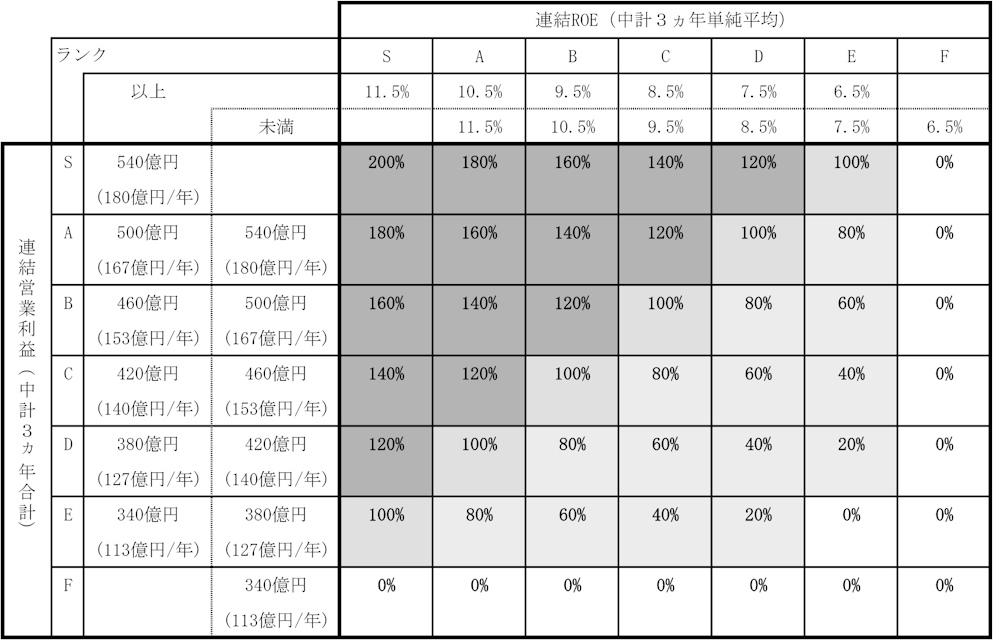
| Performance evaluation period | Three fiscal years from the fiscal year ending March 2025 to the fiscal year ending March 2027 |
|---|---|
| performance evaluation indicators | 3-year cumulative consolidated operating profit and 3-year simple average consolidated ROE |
(B) Specific calculation method
The degree of achievement of performance targets is determined by the three-year cumulative consolidated operating profit and three-year simple average consolidated ROE calculated from the consolidated balance sheet and consolidated income statement for each fiscal year corresponding to the Company's performance evaluation period. Based on the following calculations:
Calculation method for performance target achievement
2.役員区分ごとの報酬等の総額、報酬等の種類別の総額および対象となる役員の員数
| Officer classification | Total amount of compensation, etc. (illion yen) |
Total amount of compensation, etc. (million yen) | Number of eligible officers (persons) | |||
|---|---|---|---|---|---|---|
| Monthly compensation (Fixed compensation) |
Bonus (performance-based compensation) |
Restricted stock compensation (Non-monetary compensation) |
Performance-linked stock compensation (non-monetary compensation) | |||
| 取締役(監査等委員および社外取締役を除く) | 227 | 117 | 56 | 21 | 32 | 5 |
| 監査等委員(社外取締役を除く) | 16 | 16 | - | - | - | 1 |
| Audit & Supervisory Board Members (excluding Outside Audit & Supervisory Board Members) | 9 | 9 | - | - | - | 2 |
| Outside officers | 57 | 57 | - | - | - | 8 |
- ※2025年度末日(2026年3月31日)時点における取締役の在籍人員は10名(取締役(監査等委員である者を除く。)6名、監査等委員である取締役4名)です。
- ※取締役の報酬等の額には、使用人兼務取締役の使用人分の給与は含んでいません。
- ※業績連動報酬のうち、株式報酬(非金銭報酬)の額は、業績評価期間である中期経営計画期間にわたって費用を計上する業績連動型株式報酬制度に基づく2025年度における費用計上額を記載しています。
Evaluation of the effectiveness Board of Director Meeting and content of questionnaire surveys, etc.
当社では、外部機関に委託して、取締役らに対し、取締役会の実効性評価に係るアンケート調査(5段階評価方式と自由記述方式の併用)を実施しています。
このアンケート調査においてポジティブサイドの評価が多数であったことから、取締役らは、当社の取締役会の実効性が確保されていると評価しているものと判断しています。
もっとも、アンケート調査の自由記述方式での回答では、取締役会の実効性のさらなる向上に向けて積極的・多数の意見の表明がありました。
2024年度の取締役会の実効性評価の調査結果からの評価の推移や、近年、独占禁止法違反事案をはじめコンプライアンス上の問題が相次ぎ発覚したことを踏まえ、特に以下の3点を重要な課題と認識し、取締役会の実効性のさらなる向上に取り組んでいくこととします。
ⅰ)「指名・報酬委員会」の運営と取締役社長選定プロセスの高度化
すでに「指名・報酬委員会」において委員である社外取締役から同委員会の運営や開催頻度、議論の内容等について改善提案が出され、これに基づき同委員会において検討が進められており、その検討結果を踏まえて取締役社長の選定に係る取締役会の審議・監督の在り方についての認識共有、改善状況の確認・検討を行い、取締役会としての監督機能の強化を図ってまいります。
ⅱ)事業ポートフォリオ・経営資源配分の議論の深化
取締役会における「事業ポートフォリオ」や「経営資源配分」の審議の充実に向けて、あらかじめ取締役会の審議計画を策定し、これを踏まえて社内の検討・準備を行うこととしておりますが、これらの議題に関する取締役会の審議状況、取締役会としての問題意識等を執行側に適切にフィードバックすること等を通じて社内の検討・準備を充実させることにより、取締役会における「事業ポートフォリオ」や「経営資源配分」の議論のさらなる深化を図ってまいります。
ⅲ)コンプライアンス順守の企業文化構築に向けた監督の継続
引き続き、独占禁止法違反事案に関する排除措置命令の執行としての独占禁止法の順守に向けた教育・監査やイントラネット・グループ報を通じた情報発信等に取り組むほか、各部門のコンプライアンス教育の実施状況の調査結果を踏まえ、業務を遂行する上で重要となる個別の法令・順守すべき規範等についても反復・継続的に、より効果的な教育を行うことができるよう、e-ラーニングの展開・コンテンツ整備を行い、コンプライアンス教育の強化に取り組んでまいります。これらの取り組み状況について、「内部統制システム構築の基本方針」運用状況の報告等を通じて継続的にモニタリングを実施するとともに、それらの取り組みの実効性の評価や改善に向けた検討を行うことで取締役会としての監督の強化を図ってまいります。
Other matters related to corporate governance
当社は、業務の適正を確保するための体制を整備するため、取締役会において「内部統制システム構築の基本方針」を定めています。
その内容は、以下のとおりです。
System to ensure that the execution of duties by Directors complies with laws and regulations and the Articles of Incorporation
Our company conducts corporate activities in compliance with laws, regulations and social norms based on the "Corporate principles", "Management philosophy," "Action guidelines," and "Code of conduct."
代表取締役は、取締役会の決議、定款の定めに基づく取締役会からの重要な業務執行の決定に関する委任並びに稟議規程および業務分掌規程等の社内規則に基づき業務執行に関する意思決定を行うとともに、他の業務執行取締役とともに、業務を執行するものとします。そして、利害関係を有しない社外取締役を含む取締役会がこれを監督し、監査等委員会が適正性を監査するものとします。
取締役の人事および報酬に関する客観性および妥当性をより一層高めるべく、取締役会は、あらかじめ、社外取締役のみで構成する「指名・報酬委員会」に、当該人事および報酬に関する事項について諮問し、同委員会の答申に基づきこれらを決定することとします。
また、当社は、企業の社会的責任(CSR)に関する経営方針、課題や指標の検討並びにそれら課題等の達成状況のモニタリングを行うこと等を目的として「全社サステナビリティ会議」を設置します。
In addition, we have set up an internal reporting hotline (corporate ethics helpline) to ensure early detection of problematic events and the elimination of compliance risks through self-correction.
System for storing and managing information related to the execution of duties by Directors
The Company records information related to the execution of duties by directors in documents or electromagnetic media based on internal rules such as Board of Directors rules and approval rules, and retains the information for the period specified in the document handling rules.
Regulations and other systems for managing the risk of loss
The Company will develop internal rules and manuals, etc., with the departments in charge taking the lead in managing risks related to compliance, export control, information management, quality control, environmental management, and disasters, etc., and will provide education to employees, as well as provide timely information regarding thorough compliance with laws and regulations, in order to ensure their thorough implementation.
In addition, with regard to risks related to business execution, regulations stipulating risk management will be established, and each division will independently establish a risk management system that suits the characteristics of the business. On the other hand, at Head Office, each division We will establish a risk management system by monitoring the status of risk management and implementing company-wide risk countermeasures such as disaster risk and financial risk.
System to ensure that directors' duties are executed efficiently
The Company will delegate authority over the operation of individual businesses to executive officers, strengthening management functions by accelerating decision-making and clarifying responsibilities. The Company will also strive to strengthen corporate governance and improve operational efficiency through decision-making and oversight by directors regarding the evaluation of individual businesses and the allocation of management resources.
In addition, we will formulate annual and medium-term management plans that clarify the division of duties, authority, and responsibilities of the organizational and other business execution structures, and will review and revise these plans regularly.
System to ensure that the execution of duties by employees complies with laws and regulations and the Articles of Incorporation
In addition to the "Action guidelines" and "Code of conduct" that serve as guidelines for employees to act in accordance with laws and regulations, social norms, and social decency, the Company has established "ShinMaywa Corporate Ethics Day" and "Corporate Ethics Month" to promote the spread of awareness regarding compliance and the establishment of various systems.
Furthermore, the execution of duties by employees shall be carried out in accordance with laws and regulations, the Articles of Incorporation, the approval regulations, the division of duties and other internal rules. To verify this, the Internal Audit Department shall conduct internal audits, aiming to detect and eliminate compliance risks at an early stage, and shall endeavor to grasp a wide range of problematic events by utilizing the internal reporting system, etc.
System for ensuring the appropriateness of operations within the corporate group consisting of the Company and its subsidiaries
We share our "Corporate principles Credo," "Management philosophy," "Action guidelines," and "Code of conduct" with each of our group companies, and conduct our corporate activities in compliance with laws, regulations, and social norms.
In addition, based on the regulations stipulating the management of group companies, we may request reports from officers, employees, etc. (hereinafter referred to as "officers and employees") of each company in our group, as necessary, or communicate with the department in charge of our company. In addition, by dispatching our officers and employees as directors, Audit & Supervisory Board Member, etc. of each company in our group, we will strive to understand the status of business execution at each company in our group, and we will also strive to understand the status of business execution at each company in our group. We will promote reporting and discussions with the government.
In addition, we carry out internal audits led by the audit department, aiming to discover and eliminate compliance risks at an early stage, and broadly grasp problematic events by utilizing the whistle-blowing hotline that can be used by each company in our group.
Matters concerning directors and employees who assist the Audit and Supervisory Committee in its duties, and matters concerning the independence of such directors and employees from other directors of the Company (excluding directors who are Audit and Supervisory Committee members)
If the Audit and Supervisory Committee requests that employees be appointed to assist in its duties, the Company will establish an organization to assist the Audit and Supervisory Committee in its duties, assign such assistant employees, and provide support from relevant departments as necessary.
When an assistant employee is appointed to the Audit and Supervisory Committee, the opinions of the Audit and Supervisory Committee will be heard and respected regarding the transfer and evaluation of such employee.
Matters concerning ensuring the effectiveness of instructions to directors and employees who assist the Audit and Supervisory Committee in its duties
Our audit department will conduct internal audits in cooperation with the Audit and Supervisory Committee. The Audit and Supervisory Committee may issue necessary instructions regarding internal audits to the audit department, and if instructions different from those of the Audit and Supervisory Committee are issued by the Representative Director, the instructions of the Audit and Supervisory Committee will prevail.
A system for directors and employees to report to the Audit and Supervisory Committee, a system for other reporting to the Audit and Supervisory Committee, and a system to ensure that no one is treated unfavorably for making such a report
Directors who are Audit and Supervisory Committee members (hereinafter referred to as "Audit and Executive Committee Committee members") will receive reports from Board of Director Meeting or employees on the status of business execution and other important matters at the Board of Directors meetings, management meetings, and other important internal meetings they attend. In addition, upon request from the Audit and Supervisory Committee, they will receive reports on matters necessary for the Audit and Supervisory Committee to perform its duties. Furthermore, we strive to ensure that Audit and Supervisory Committee members have opportunities to regularly exchange opinions with the Representative Director and Outside Directors who are not Audit and Supervisory Committee members. We also strive to ensure that Audit and Supervisory Committee members have opportunities to exchange opinions and share information with officers and employees of the Company and each Group company. The audit department will report to the Audit and Supervisory Committee on the status and results of internal audits of the Company and each Group company. Furthermore, the Company will not treat officers or employees who report or make internal reports to the Audit and Supervisory Committee or whistle-blowing system regarding the performance of their duties in a detrimental manner.
Matters concerning the procedures for advance payment or reimbursement of expenses incurred in the execution of duties by the Audit and Supervisory Committee members (limited to those related to the execution of duties by the Audit and Supervisory Committee) and the policy for processing expenses or debts incurred in the execution of such duties
If an Audit and Supervisory Committee Member requests advance payment or reimbursement of expenses incurred in the performance of their duties, the Company will comply with such request, except when it is deemed not necessary for the performance of the Audit and Supervisory Committee's duties.
Other systems to ensure that audits by the Audit and Supervisory Committee are carried out effectively
In response to requests from the Audit and Supervisory Committee, the Company will disclose important documents such as approval documents, and will investigate, report and explain the duties of directors and employees. In addition, the Company will provide opportunities for the exchange of opinions with the accounting auditor.
Other matters
Requirements for resolution for appointment of Board of Directors
The Articles of Incorporation stipulate that resolutions for the appointment of Directors shall be made by a majority vote in the presence of shareholders holding at least one-third of the voting rights of shareholders who can exercise their voting rights. Additionally, the articles of incorporation stipulate that resolutions for the election of directors shall not be based on cumulative voting.
Items that allow matters to be resolved at a General meeting of shareholders to be resolved at a Board of Directors meeting
Acquisition of own shares
In order to enable the execution of flexible capital policies in response to changes in the business envrionment, the Company acquires its own shares through market transactions, etc. by resolution of the Board of Directors pursuant to the provisions of Article 165, Paragraph 2 of the Companies Act. The articles of incorporation stipulate that this can be done.
Interim dividend
In order to flexibly distribute profits to shareholders, the Company shall, by resolution of Board of Director Meeting, make distributions to shareholders or registered stock pledgees listed or recorded in the final shareholder register as of September 30th of each year, pursuant to the Companies Act. The articles of incorporation stipulate that the company may make dividends from surplus (interim dividends) as stipulated in Article 454, Paragraph 5.
Special resolution requirements for General meeting of shareholders
Regarding special resolutions at General meetings of shareholders pursuant to the provisions of Article 309, Paragraph 2 of the Companies Act, the Company shall ensure that shareholders holding at least one-third of the voting rights of shareholders who are eligible to exercise their voting rights are present and that their voting rights are The articles of incorporation stipulate that a two-thirds or more vote is required. The purpose of this is to ensure that general shareholders' meetings run smoothly by relaxing the quorum required for special resolutions at general shareholders' meetings.
Limited liability contract
Pursuant to the provisions of the Articles of Incorporation, the Company has individually concluded agreements with all Outside Directors and Directors who are Audit and Supervisory Committee Members that limit their liability for damages under Article 423, Paragraph 1 of the Companies Act. The limit on liability for damages under these agreements is the minimum amount stipulated by law.
Directors Liability Insurance Contract
We have concluded Directors' Liability Insurance contracts with insurance companies, pursuant to Article 430-3, Paragraph 1 of the Companies Act, with our directors as insured. This insurance contract provides for compensation for damages and litigation costs up to a maximum of 2 billion yen in the event that the insured is liable for damages in connection with the performance of his/her duties, and the Company bears the full insurance premiums. The contract with the insurance company also provides for the exclusion of compensation for damages incurred by the insured arising from the insured's improper performance of his/her duties, such as claims for damages arising from the insured's illegal acceptance of personal benefits or conveniences, claims for damages arising from the insured's criminal acts, and claims for damages arising from decisions or actions made by the insured beyond the authority granted by the company, thereby preventing the insured from impairing the appropriateness of the performance of his/her duties.
Promoting and enhancing dialogue with shareholders
In addition to appropriately providing necessary and useful information for shareholders to properly exercise their voting rights, the Company strives to engage constructively with shareholders by holding financial results briefings and regularly conducting shareholder surveys. We strive to promote and enhance dialogue. We have established an appropriate system for dialogue with shareholders, such as reporting the opinions of shareholders ascertained through these dialogues to the Board of Directors and other relevant officers and departments.