


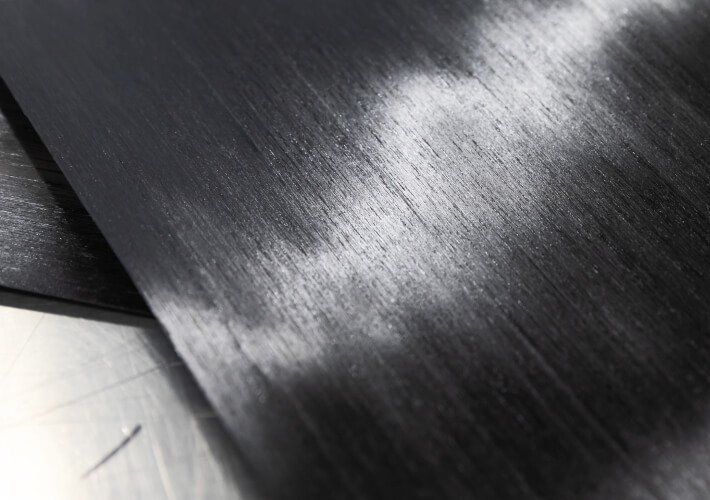
Thermoplastic Composite Materials
Thermoplastic composite materials are made by combining fibers and thermoplastic resins. Materials that use carbon fibers are referred to as thermoplastic carbon fiber reinforced plastics (CFRTP).
Since 2019, our company has been engaged in research and development utilizing thermoplastic CFRP.
Advantages


Shortened and Lower-Cost Manufacturing Processes
Thermoplastic CFRP is formed through a phase transition process in which the resin is melted by heating and solidified by cooling, without involving chemical reactions. This enables molding cycles of only several tens of minutes. In addition, because no volatile gases are generated and the resin exhibits high fluidity in the molten state, residual air is minimized. As a result, high-speed and automated processes such as press molding can be applied instead of autoclave molding, leading to reductions in manufacturing time as well as equipment and production costs.


Reduced Environmental Impact During Storage and Disposal
Because thermoplastic CFRP does not involve curing reactions, refrigeration is not required, and the material can be stored at room temperature. This characteristic provides an extremely long shelf life, significantly reducing waste generated during long-term storage. Furthermore, molded parts can be remolded by reheating. This high level of reusability promotes material recycling and greatly contributes to reducing environmental impact.


Weight Reduction and Process Simplification Through Welding
Thermoplastic CFRP parts can be welded together after molding by applying heat and pressure. This capability allows components to be integrated without the use of bolts or adhesives that were previously required. As a result, weight is reduced by minimizing fastening parts, and the manufacturing process is simplified and shortened by eliminating bonding and mechanical fastening steps.
Aircraft Components in Development
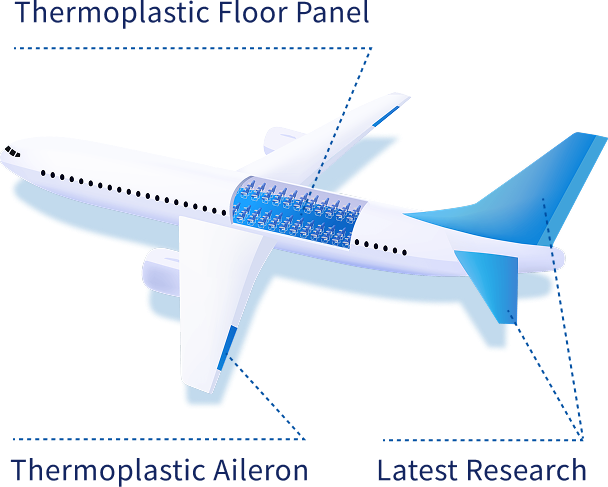
Thermoplastic Floor Panels
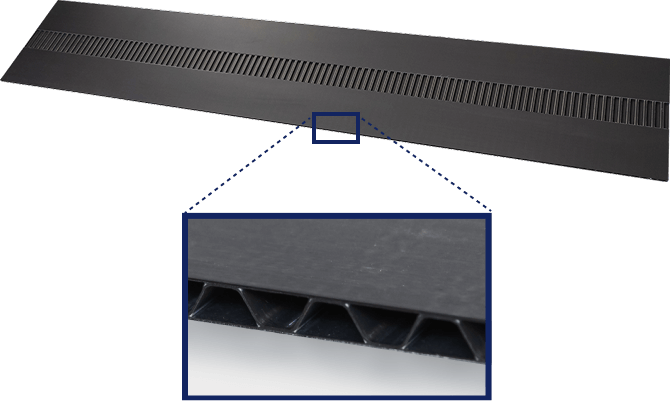
Compared with conventional honeycomb sandwich panels, this technology is expected to provide the following performance improvements:
Weight
Shape optimization

Manufacturing time
Eliminating the autoclave process

Manufacturing cost
Efficient and automated press forming

Furthermore, because thermoplastic CFRP can be remolded and the ailerons are manufactured as single-material structures, material sorting during recycling is unnecessary.
This results in an innovative solution with excellent environmental performance.
For more details, please visit the NEDO website.
Thermoplastic Aileron
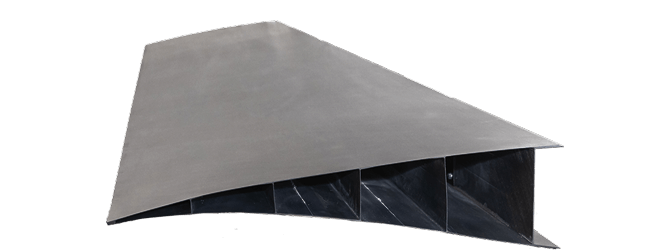
Compared with conventional metal ailerons, this technology is expected to provide the following performance improvements:
Weight
Shape optimization

Manufacturing time
Eliminating the mechanical fastening process

Manufacturing cost
Reducing the number of parts and simplifying the manufacturing process

Furthermore, because thermoplastic CFRP can be remolded and the ailerons are manufactured as single-material structures, material sorting during recycling is unnecessary.
This results in an innovative solution with excellent environmental performance.
For more details, please visit the NEDO website.
Latest Research
With a view to achieving aircraft production rates of approximately 80 aircraft per month in the 2030s, the development of even more efficient molding technologies has begun. Through significant improvements in productivity, the application of thermoplastic CFRP components is expected to be expanded.
Target Component: Tail Fin Ribs
